Alberobello
Alberobello
1,600 trulli, two neighborhoods, and a history born from a 15th-century tax loophole: Alberobello, a UNESCO jewel of Puglia, awaits your discovery.
Alberobello is a small town in southern Italie, three hours by train from Bari, nestled in the abundant region of Puglia. Known as the capital of the "trulli," it stands as an authenticity seeker's dream destination.
Visiting Alberobello is a privilege for travelers in pursuit of cultural immersion and heritage. The magic unfolds as you enter the Itria Valley, where the air carries the scent of Mediterranean pines and wild herbs. Stroll through wooded landscapes, experience falconry, taste local white and red wines, discover olive oil production sites... Agritourism is a flagship attraction of this small town of 10,654 inhabitants, ideally positioned in Puglia, Italy's rich agricultural heartland. Yet Alberobello's greatest treasure lies in its conical-roofed peasant dwellings, known as "trulli," which earned it UNESCO World Heritage status in 1996. Book your flight to Alberobello today and fulfill your craving for authentic travel in Puglia!
History
Founded in the 16th century, Alberobello is young compared to other Italian cities. It was originally a county ruled by Andrea Matteo III Aquaviva d'Aragon and inhabited by some forty peasant families. The Counts of Conversano succeeded one another as lords through hereditary rights, wielding among the greatest power and wealth in the Kingdom of Naples.
The "trulli" visible today emerged during the second half of the 19th century. They were born from an ingenious scheme devised by the reigning Count of Conversano to avoid paying taxes to the royal court of Naples. The Aragonese Code, promulgated in 1466, required feudal possessions to pay tribute to the crown for every permanent structure. Seeking to escape this obligation, the count forced his tenant farmers to construct their homes using dry-stone methods, without mortar or binding agents. These distinctive dry-stone dwellings could be quickly dismantled during royal inspections. Community life flourished within these "trulli," from small farmhouses to parish churches and administrative offices. Over time, the County of Conversano evolved into a sprawling urban settlement.
Alberobello remained under the grip of the noble Acquaviva d'Aragon family of Conversano until the late 18th century. June 16, 1797, marks an unforgettable moment in the town's chronicles: the royal edict of Ferdinand IV of Bourbon arrived, proclaiming the liberation of feudal lands. The decree was greeted with jubilation. From that moment forward, Alberobello became a royal city.
World War II transformed Alberobello into a place of terror, suffering, and desolation. The Gigante farm, requisitioned by Mussolini's fascists, served as a transit and concentration camp. It was later repurposed as a youth rehabilitation center in 1972.
Today
Young, vibrant, and blossoming, sheltered from mass tourism, Alberobello has preserved an impeccably picturesque character. Nothing has changed in residential styles. Peaceful alleyways lined with grey stone cottages invite leisurely wandering, while olive groves, wild herbs, and lavender fields compose a bucolic Mediterranean tableau.
While agriculture still employs considerable labor—particularly in wine and olive oil production, which have made the town famous—it now takes a back seat to cultural tourism. From a simple farming community, Alberobello has transformed into a globally renowned tourist destination. The "trulli" attract visitors from around the world year-round. Local craftsmanship thrives on this tourism boom: ceramics, jewelry, and woven textiles crafted by village women flourish in local shops.
Although many trulli now house restaurateurs, hoteliers, and souvenir merchants, Alberobello has maintained the charm of a peaceful town where life unfolds at a gentle pace. As the most celebrated attraction in Puglia, the "trulli capital" offers abundant warmth and hospitality, guaranteeing you a welcoming and authentic journey.
The "Trulli," Traditional Dwellings
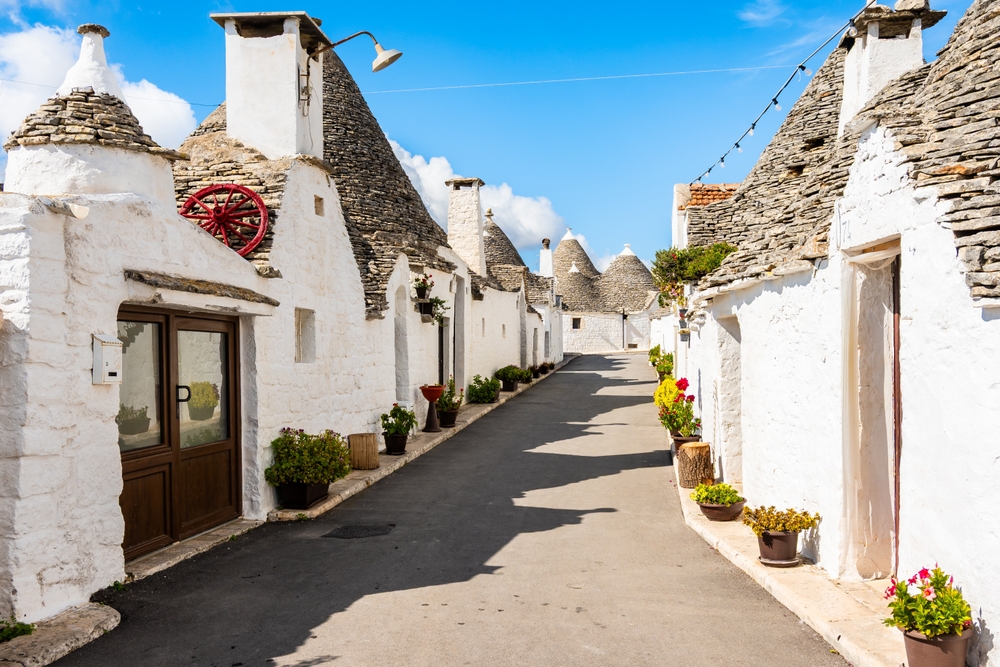
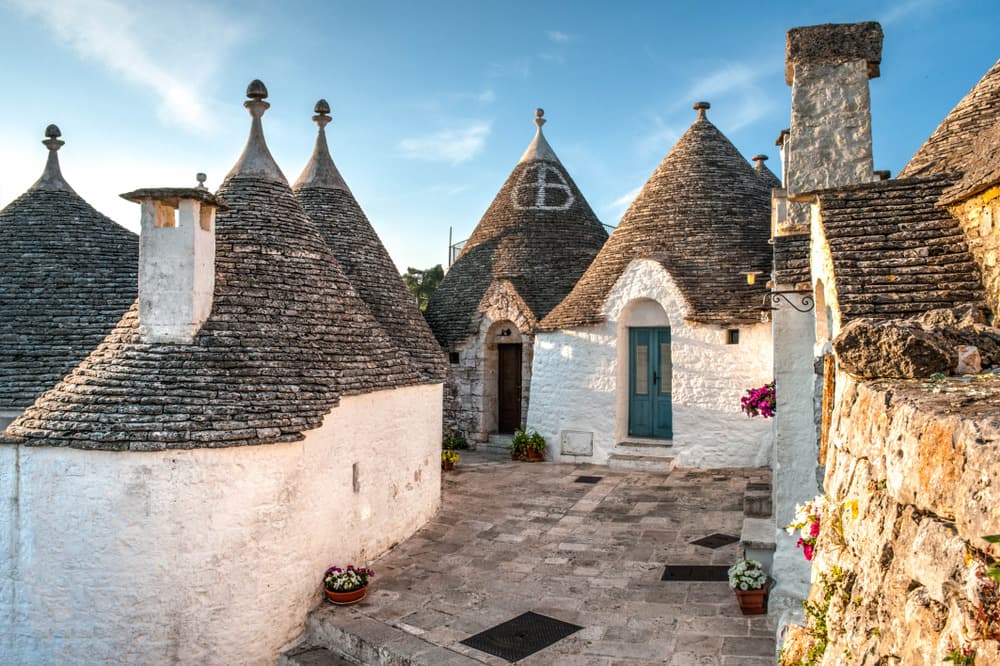
Trulli—or trullo in singular—are the defining feature of the landscape. Wherever your gaze falls, low stone houses whitewashed with lime fill the alleyways. They stand as striking testimonies to mortarless architecture inherited from ancient times. Beyond construction technique, the trulli's form captivates equally: the base is circular, while the roof rises in a pointed or conical dome fashioned from stone pebbles laid in concentric rings. Decorative symbols adorn the rooflines: elaborate graphic motifs drawing from Christian and secular traditions. Their number is estimated at 1,600, making Alberobello the "trulli capital" of the Itria Valley.
To explore this exceptional urban heritage, dedicate a full day to wandering the Monti neighborhood. It harbors the highest concentration of traditional dwellings. You'll discover them along narrow streets winding through a wooded hillside. If you wish, pause for refreshment sipping a regional beverage on the panoramic terrace of a modern trullo. Artisans also operate shops within the "trulli": linen tablecloths, lace shawls and scarves, embroidered handbags... The textile craftsmanship demonstrates admirable skill, fashioned by village women versed in textile arts. Numerous ceramic pieces are sold throughout the Monti district, painted with rooster motifs or blue flowers symbolizing fertility.
Believe it or not, a handful of farmers still inhabit traditional "trulli." To meet them, venture beyond Monti into the Aia Piccola neighborhood. Whereas the first is touristy with its commercial "trulli," the latter remains genuinely authentic. What of staying with local families in Alberobello? Aia Piccola remains a residential zone, where dry-stone dwellings shelter people living simple, tranquil countryside lives. There's no hot water or wifi. Comfort is spartan, yet the warmth and hospitality of the farmers make it worthwhile.
The Sovereign Trullo: this uniquely designed "trullo" features two stories and a staircase. Now converted into a museum, it hosts summer theatrical performances, music and dance concerts, and other cultural programs.
Discovering Prehistoric Caves
Approximately 15 km from Alberobello, the Castellana Caves rank among Italy's largest natural caverns. An impressive geological formation, 100 million years old, unfolds before you. You'll traverse a network of underground cavities extending 3.39 km where stalactites, stalagmites, alabaster columns, and dazzling rock formations burst forth from every direction. For those craving pure adventure, follow the trail of Franco Anelli, the pioneering speleologist who discovered the Castellana Caves in 1938, on an exhilarating journey lasting between 50 minutes and 2 hours.
Timid visitors seeking adventure may visit the Franco Anelli Speleology Museum located at the cave entrance.
Religious Heritage
After exploring the famous "trulli," pay homage to Alberobello's fascinating churches:
- The Basilica of Saints Cosma and Damiano: constructed around 1636 on the orders of Count Giangirolamo II to thank Saints Cosma and Damiano for answering his wife's prayers, the basilica was enlarged and renovated multiple times before acquiring its current neoclassical style in 1885. It houses the celebrated relics of the sainted physicians.
- Church of Saint Anthony of Padua: completed between 1926 and 1927, the Church of Saint Anthony of Padua is a splendid structure designed in trullo form. It displays relics, sacred icons, and bas-reliefs.
When to Visit?
Situated in the heart of Puglia, Alberobello experiences the typical Mediterranean climate of the south. Long dry summers and mild winters characterize this region. Average temperatures range from a minimum of 10°C in January to a maximum of 24°C in July. While winter is relatively cool, most rainfall arrives during this season. November is the wettest month (100 mm of precipitation). The months from November through March are therefore best avoided.
For planning a family vacation to Alberobello, opt for peak summer dates, between May and August. With over 10 hours of daily sunshine, you can enjoy outdoor activities like exploring the trulli on foot, or relish unlimited beach time along the Adriatic coast.
To reach Alberobello, French nationals can book round-trip Paris-Bari flights. Bari Airport, also designated "Bari-Palese Macchie," is the closest airport to the destination and the primary gateway to Puglia. The most active airlines serving this route are Ryanair, Lufthansa, and easyJet.
To cover the 66 km separating Bari Airport from Alberobello, you may choose between train or bus. By rail, Alberobello is served by FSE (Ferrovie del Sud Est) trains departing from Bari's central station. The journey takes approximately 3 hours with a connection in Putignano. By road, direct buses depart from Bari Largo Sorrentino and reach Alberobello's town center in about an hour.
Must-Do Activities
- Wander through endless olive groves and vineyards
- Watch eagles and falcons soar above the Itria Valley
- Visit charming farming villages
- Take a guided tour of the city focused on the "trulli" theme
- Connect with local residents
- Savor Apulian specialties: honey, dairy, cheeses, dried fruits, and more
- Explore the legendary Castellana Caves
- Capture photos of the neoclassical façade of the Church of Saints Cosma and Damiano
- Discover the relic of Saint Anthony of Padua within its namesake church
Want to discover this destination?
Our local advisors design your tailor-made trip.