Catania
Catania
At the foot of Mount Etna, Catania blends UNESCO Baroque architecture, bustling fish markets, black sand beaches and Sicilian tables. The complete guide to visiting the "Milan of the South."
Italy harbours countless fascinating cities, among which stands Catania. Nestled on the eastern coast of Sicily, at the foot of Mount Etna, this city offers remarkable discoveries for the most curious travellers. Home to immense architectural treasures combined with grandiose natural landscapes, Catania's historical significance—recognised by UNESCO in 2002—is inscribed in gold letters across its churches, monuments and buildings exemplifying Baroque art. Ideally situated along the waterfront, facing the magnificent cove of San Giovanni Li Cuti, this city invites unusual discoveries for the most adventurous visitors. Whether you crave architectural wonders, dream of mountain tourism at Mount Etna, or seek a tranquil beach escape, the Milan of the South will fulfil your desires for adventure.
History
Originally founded by Greek colonists, Catania was later conquered by Syracuse before falling under Roman control. During the Renaissance period, in the 14th century, Catania's first university was established. Since then, the city became one of Italy's most important cultural, artistic and political centres.
Catania fell victim to two violent earthquakes that completely destroyed the city in 1169 and 1693. However, the most devastating blow came from the 1969 earthquake, which ravaged much of south-eastern Sicily. Years later, the city was rebuilt in Baroque style and remains in this form today.
Today
An important port city, Catania is today Sicily's undisputed industrial capital. Nicknamed the "Milan of the South" since the 1960s, it is the economic lifeline of the region.
Its history, culture and gastronomic traditions contribute to its renown. At the height of summer, mountaineering activities animate Mount Etna's tourist facilities, offering luxury hotels and world-class cable cars. Yet Catania is primarily known for its exceptionally rich architectural heritage, alternating between monuments, cathedrals, Byzantine churches, fortresses, Roman relics, and small shaded squares where fountains sing. Like much of south-eastern Sicily, Catania stands as one of the most characteristic urban centres of late Baroque art. The city truly deserves a visit.
Places of Interest to Visit
Although many of the city's ancient Roman monuments have been destroyed, various remains have survived, preserving their original form or with a renewed style. Furthermore, in response to the seismic event of 11 January 1693, Catania witnessed feverish and ambitious construction, resulting in grand architectural and urban ensembles reflecting the expression of Baroque art.
To begin your stay in Catania, treat yourself to a timeless visit to the Greco-Roman theatre on Via Vittorio Emanuele. Surrounded by more recent buildings, it stands as one of the finest Roman structures one can see today. Nearby, also discover the Odeon, a building that once accommodated up to 1,500 spectators.
After exploring the Greek Acropolis on "Montvierge Hill" and the Roman Amphitheatre, whose brick and marble ruins will set your imagination free, you can continue to the Church of Santa Maria della Rotonda, built upon the remains of Roman baths.
After a journey through Roman antiquity, let us contemplate medieval Italy by heading to the Piazza del Duomo, the city's main square. It is hard to imagine that this tranquil spot, where Catanians stroll without a care, was 400 years ago a centre of public life where the great affairs of the Sicilian Kingdom were decided. The square hosts a unique gathering of palaces, buildings and monumental churches.
The Palazzo degli Elefanti (Palace of Elephants) dominates the northern side. Its façade bears pilasters enriched with diamond patterns, featuring balconied windows with curved pediments. In the entrance hall, you will delight in finding the "Senate Carriages," a pair of 18th-century carriages mounted during the festivities of Saint Agatha, the city's patroness.
The Palazzo del Seminario dei Chierici (Palace of the Seminaries of the Clergy) rises on the southern side. Completely destroyed in 1693 and redesigned in Baroque style, the palace was first a property of the bishopric before being acquired by the municipality. The working of natural stone on the façade is of great finesse.
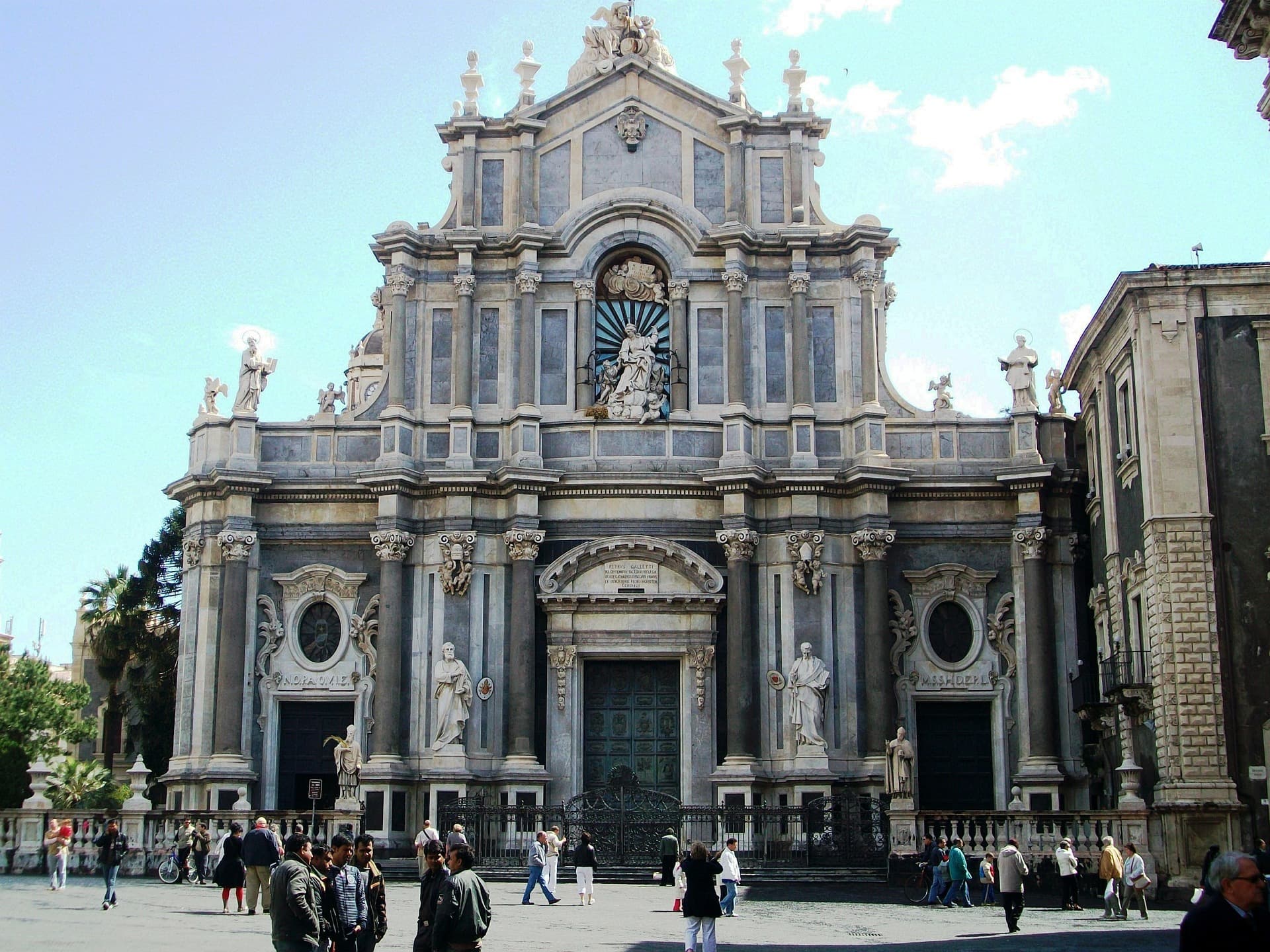
On the eastern side, the majestic Cathedral of Saint Agatha will leave you speechless. Restored in 1736, the building houses royal tombs and the Treasury Chamber of Saint Agatha, where the relics of the virgin martyr who suffered persecution by the consul are piously preserved. Flanked by marble statues of Saint Agatha, Saint Beryllus and Saint Euplius, the church's façade is a resplendent masterpiece of Baroque art.
Throning in the heart of the Piazza del Duomo, the Elephant Fountain is the symbol of Catania. It was built around 1737 by Giovanni Battista Vaccarini. The water jets are topped by a black basalt elephant carrying on its back an obelisk standing 3.66 metres high, reminiscent of the Obelisk of Minerva in Rome.
Head next towards Mount Etna by passing through the Museo Diocesano or Diocesan Museum, which occupies the Palace of the Seminaries of the Clergy. This museum houses a rich collection of religious artefacts, including wooden and marble furniture, liturgical vestments, gold and silver reliquaries, pastoral staffs and many other treasures. Among Catania's other notable sites are the Norman cathedral, the Massimo Theatre, Castello Ursino, the Benedictine monastery and the unfinished adjoining Church of Saint Nicholas.
Apart from the Piazza del Duomo, Catania has other public squares: Piazza Cavour, Piazza Dante, Quattro Canti, Piazza Stesicoro, and more. The architecture is beautiful; these small squares are primarily frequented for dining, having a drink or shopping.
To cool off after a long stroll, head to Villa Bellini. Open to the public, the villa's gardens shelter meadows, century-old trees and various rare plant species.
On the gastronomy side, fine food lovers will appreciate local specialities such as pasta alla Norma (pasta accompanied by aubergines, basil, fresh ricotta and tomatoes), Messina l'agghiotta di pesce spada (swordfish with pine nuts, sultanas, capers, olives and tomatoes), and Crespelle and Canneloni di ricotta.
Climate
Catania enjoys a Mediterranean climate with very hot and very dry summers. Heat can be overwhelming, reaching up to 33°C; indeed, the sirocco blowing during summer brings intense warmth.
The worst months to avoid are January, November and December, as rain becomes troublesome.
Winters are mild with temperatures rarely dropping below 10°C. This season is not advisable due to sea temperatures that don't permit swimming and water sports.
To enjoy sunny holidays in Catania, it is best to choose dates between June and September.
Located just 5 km south of Catania's centre, Catania-Fontanarossa Airport, now called Vincenzo Bellini Airport, provides links between the city and numerous European destinations. From the airport, several airlines offer flights to Rome, Bastia, Bologna, Genoa, Milan, Naples, Perugia, Pisa, Turin, Venice, Verona, Barcelona, Berlin, Bucharest, Madrid, Malta, Manchester, Paris and Stuttgart. For your convenience, bus services and taxis serve the airport and easily transport passengers to the city centre.
For those opting for rail travel, a number of regular trains cross the main Italian cities such as Messina, Taormina, Giardini, Naples, Rome, Enna, Palermo, Syracuse, Pozzallo and Caltagirone.
By sea, several night ferries operate between Naples and Catania and between Genoa and Civitavecchia. Furthermore, you can also take a ferry from Valletta in Malta.
By road, the city has frequent buses serving Taormina, Messina, Enna, Caltanissetta, Ragusa and Syracuse.
In Catania, you can get around on foot, by bicycle, by bus, by taxi, by train or simply by rental vehicle.
Want to discover this destination?
Our local advisors design your tailor-made trip.