Florence
Florence
Florence, capital of Tuscany and cradle of the Renaissance, concentrates the Duomo, the Uffizi Gallery, Ponte Vecchio and Medici masterpieces within a UNESCO-listed historic center.
Embodying the authentic essence of Italy, with a cultural and artistic heritage spanning all eras, Florence needs no introduction. The fact that it hosted the G7's first meeting devoted to culture in March 2017 testifies to its global significance.
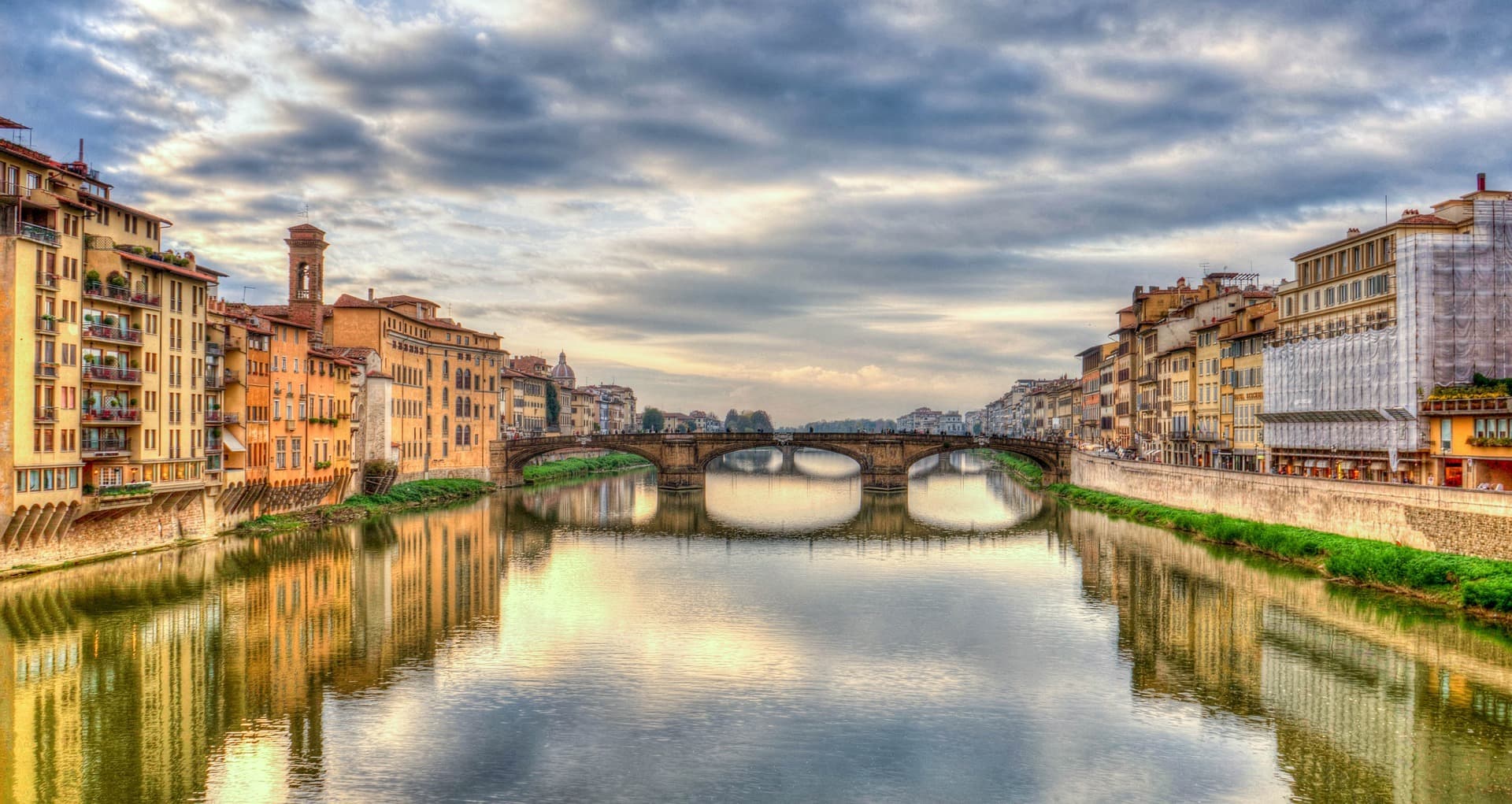
Traversed by the Arno River, at the heart of the Tuscany region, Florence offers a picturesque setting of plains, rolling hills and forested mountains. Yet its primary appeal lies in the caliber of its museums and monuments, particularly the Cathedral of Santa Maria del Fiore, which draws millions of visitors annually. A UNESCO World Heritage city, Florence stands as a premier destination for exceptional Italian vacations.
History
Florentia, its original name, was born from Roman civilization. A modest town through the 12th century, it then experienced remarkable economic growth under the rule of various signories. The cloth and wool manufacture, jewelry-making, goldsmithing and coin production flourished, carrying the city's reputation far beyond its borders—so much so that it earned the title "Athens of the Middle Ages."
In 1348, the city fell victim to the Black Plague, which claimed half its population.
Various noble families took turns controlling the city, notably the Medici family, who contributed enormously to promoting art and painting throughout Italy. Florence also weathered successive religious upheavals and republican revolts. Between 1865 and 1871, it briefly served as the capital of the Kingdom of Italy.
Owing to its exceptional architectural value, Florence's historic center was designated a UNESCO World Heritage site in 1982.
Discovering Florence
Capital of Tuscany, Florence is the quintessential symbol of the Renaissance. For some, it represents Italy of museums and fine arts, home to some of Europe's greatest masterpieces of painting. For others, Florence is the poetic city that inspires writers past and present. For couples, its ancient market squares, art galleries and Medici villas with fountains, gardens and gracefully sculpted arcades make it an ideal destination for an unforgettable honeymoon. In essence, it stands as a premier travel destination in Italy and throughout Europe.
Beyond its extraordinary architectural and artistic heritage, the city unfolds a charming landscape of hills, rivers and green spaces, making it even more captivating.
To make the most of Florence's essential highlights, a guided tour of the city's principal squares is highly recommended before moving on to museums, art galleries, Romanesque basilicas, medieval towers and fortresses, or Roman ruins.
Key Squares
Piazza del Duomo: dominated by the Cathedral of Santa Maria del Fiore, whose half-Gothic, half-Renaissance façade inevitably captures attention. Visiting in person, the legends surrounding the cathedral will give you a sense of the Church's power in the Middle Ages. Among other important buildings on the square, take note of Giotto's Campanile, standing 84 meters high directly opposite the cathedral, the Palazzo Strozzi of Mantua, which belonged to the Guadagni family, close associates of the Medici, and the Palazzo dei Canonici, whose façade is enhanced by statues by Arnolfo di Cambio and Filippo Brunelleschi—two giants of Florentine architecture. Also worth visiting are the Torrini Museum, dedicated to goldsmithing, and the Museo dell'Opera del Duomo, which showcases sculpture and architecture representative of the Renaissance.
Piazza della Signoria: at the heart of old Florence, Piazza della Signoria houses the Palazzo Vecchio, remarkable for its precision-cut stone finish, the Palazzo Uguccioni, whose classical forms are attributed to Michelangelo, and the Palazzo Assicurazioni Generali, built in 1871, which once served as offices for insurance companies. The square also owes its charm to lovely sculptural ensembles: Hercules and Cacus, Judith Slaying Holofernes, Perseus, Neptune, a replica of Michelangelo's David, and more. Mythological gods stand alongside heroes of Christian faith.
Museums and Art Galleries
The city of Florence boasts countless museums where world-renowned artworks are preserved and displayed.
Uffizi Gallery: Cosme the Elder, Grand Duke of Tuscany, had a passion for the arts that led him to establish a suitable space to preserve the Medici family's artistic treasures. Spanning 12,000 square meters, the museum houses one of Italy's finest collections of paintings; Botticelli's Spring and Birth of Venus, Titian's Flora, or Leonardo da Vinci's Adoration of the Magi are merely highlights. Masterworks from the German School and the Fontainebleau School are also featured: Albrecht Dürer, Cranach, Francisco de Goya... For sculptures, the Roman statue of Niobe merits particular admiration.
Galleria dell'Accademia: to truly grasp the richness of Florentine painting and sculpture, visit this gallery. Founded in 1563, the institution was initially called the "Academy of Drawing of Florence" and boasts being Europe's first school of the arts. Four centuries of Florentine painting are represented, with notable works by Botticelli, Uccello, Ghirlandaio and Perugino. Sculpture is equally prominent: Michelangelo's white Carrara marble David is housed here. Standing 4.34 meters tall, the statue is considered a masterpiece of the Italian Renaissance.
Museum of the Works of Pisa Cathedral (Museo dell'Opera del Duomo): the building welcomes art enthusiasts at the heart of the Duomo Square. Erected in the late 12th century, it initially housed canons before being passed to a private collector. The museum is organized into 25 thematic sections: wooden marquetry, vases, busts, fountains, Corinthian capitals, Henry VIII's funerary monument, religious paintings, and more. The collection is incomparably rich!
Beyond these three museums, other venues deserve a visit for art enthusiasts. The Medici Chapel, the San Marco Museum, the Bargello Museum, the Pitti Palace... Quite overwhelming, isn't it? For guidance, head to the convent museum San Marco if you enjoy paintings of Christian inspiration, such as the Annunciation, the Nativity, the Lamentation of Christ, the Crucifixion, the Last Supper, Damnation... Visit Pitti Palace to appreciate the artistic heritage of Tuscany all at once; but if you wish to discover something other than painting, the Bargello Museum is an ideal refuge.
Remarkable Churches and Cathedrals
- Cathedral of Santa Maria del Fiore (Santa Maria del Fiore): alongside the Palazzo Vecchio, this is Florence's finest architectural icon. Dominating Piazza del Duomo, this Florentine church with its Gothic façade crowned by a red marble dome was the largest place of worship in the world when inaugurated in 1536. Today, it ranks fifth behind Saint Peter's Basilica, Saint Paul's Cathedral, the Cathedral of Seville and the Cathedral of Milan.
- Baptistry of Saint John: facing the Cathedral of Santa Maria del Fiore stands the octagonal façade of the Baptistry. It offers insight into the dominance of the Catholic Church when you learn that the Baptistry witnessed the consecration of kings, knights' oaths of honor, and court poets. The building is accessible through three bronze portals. The Gates of Paradise, located on the east side, rank among the most beautiful expressions of Renaissance sculptural art. They were created by Lorenzo Ghiberti. The door features six panels of biblical figures on each leaf: the Queen of Sheba's visit, original sin, Joseph thrown into a well and sold by his brothers, Cain's fratricide, and more. The Baptistry merits a visit, especially if traveling with children.
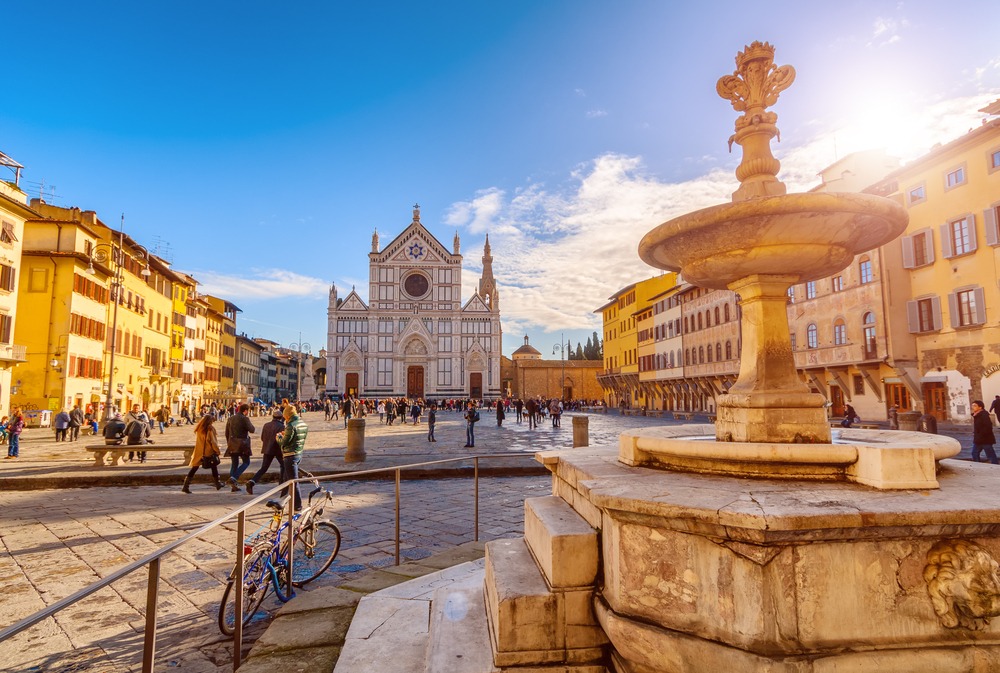
- Santa Croce Basilica: constructed in 1294 under the direction of Arnolfo di Cambio, Santa Croce Basilica is an undisputed symbol of Florentine art. It received visits from numerous religious figures from Rome, including Bernard of Saint-Pierre, Saint Bonaventure and Saint Anthony of Padua. The church's interior houses a series of Italian and Venetian frescoes.
Beyond these attractions, Florence offers numerous activities to enhance your stay in Italy. Behind the Pitti Palace lies the breathtaking Boboli Garden. Lavishly designed and graced with fascinating sculptures, it not only offers visitors a delightful discovery but also affords stunning views of the city. Other notable attractions include Santa Maria del Carmine, Piazzale Michelangelo, San Miniato al Monte, Santa Felicita, Palazzo Vecchio and the Mercato del Porcellino.
Gastronomy
As for gastronomy, Florentine cuisine is predominantly meat-based. Treat yourself to Antipasto, Panzanella, Bistecca alla fiorentina, Tripes alla fiorentina, Lampredotto, Pappardelle sulla lepre, Ribollita and Pappa al pomodoro, as well as Schiacciata alla fiorentina.
Climate
In northern Italy, Florence experiences mild winters and hot, scorching summers. The Mediterranean climate is thus quite similar to that of the French Riviera. The difference is that brief rainfall can occur in summer. November is the wettest month while July is the driest. The average annual temperature hovers around 14.5°C.
To make the most of your vacation in Florence, plan to visit between June and October.
Reaching Florence is remarkably easy today, whether by air, rail or road.
By Air
The Amerigo Vespucci International Airport, commonly known as Peretola, is your landing hub. Opened in 2010, it lies in the municipality of Sesto Florentino, 4 km from central Florence. Daily flights depart to major European cities including London, Frankfurt, Vienna, Bucharest, Munich, Madrid, Amsterdam and Geneva. For Paris-Florence flights, you can book with Air France, Vueling, KLM and Delta, among the most active carriers. Note that Paris is a mere 1 hour and 40 minutes' flight from Florence.
By Train
No direct rail link connects Paris to the city center. To reach Florence by rail, you'll need to change trains once or twice. Trains depart from Paris-Gare-de-Lyon and arrive at Florence-Santa-Maria-Novella, requiring a connection at Torino Porta Susa. The entire journey takes 9.5 hours.
Modern, rapid trains serve the railway station, connecting it to Italy's major cities. Beyond this main station, Florence has two other railway stations: Firenze Campo Marte and Firenze Rifredi.
By Bus
Eurolines bus services connect Florence to Paris. However, if you're vacationing in Rome or Milan and plan to visit Florence, know that the city is well-connected to the rest of the country via an extensive road network.
The tram is the best way to explore Florence. That said, dedicated walkers can certainly enjoy exploring on foot. Plus, as everywhere in Italy, you'll also find buses, taxis and various bicycle and car-with-driver rental services.
Want to discover this destination?
Our local advisors design your tailor-made trip.