Trieste
Trieste
Between the Adriatic and the Karst Plateau, Trieste preserves its Austro-Hungarian heritage, literary cafés and Miramare Castle. Our complete guide.
Capital of the Friuli-Venezia Giulia region, Trieste is a charming city with a calm and pleasant atmosphere. Its historical treasures, its artworks and its Central European character place it among the must-see circuits of Italy.
History
Due to its position at the head of the Gulf, Trieste was influenced by Latin, Slavic and Germanic cultures. Between 1382 and 1918, the city was under Habsburg monarchy rule. During the 19th century, the Habsburg monarchy was one of the great powers of Europe and Trieste was its most important maritime port.
During the 1930s, Trieste experienced economic revival. Thus, after the Second World War, the city took on major importance in the struggle between East and West. At the end of the 19th century, it became a renowned center for literature and music.
Today
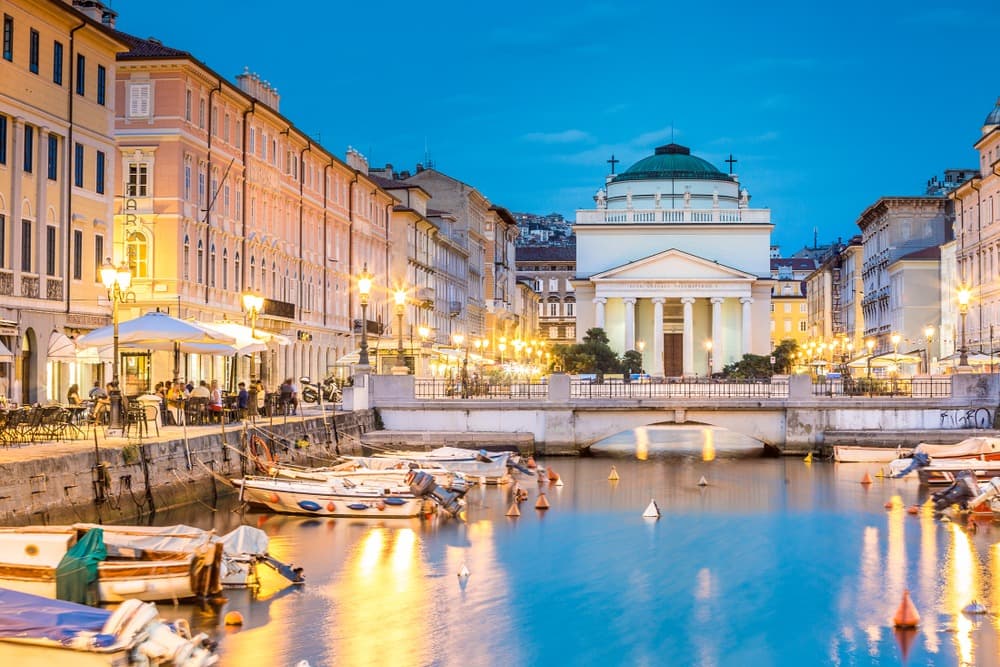
Bordered by the impressive Karst Plateau, the charming city of Trieste is a perfect base to discover a rich repertoire of history and art. Discover the Arco Riccardo, the Cathedral of San Giusto, San Giusto Castle, the Roman Theatre, the Lapidary Garden and the Synagogue. Be sure not to miss the Piazza dell'Unità d'Italia either, a delightful public square. Surrounded by magnificent neoclassical buildings, with one side of the square facing the sea, this place is simply splendid.
Beyond historical sites and monuments, Trieste includes other interesting places evoking different eras, notably the Revoltella Museum, the Museum of History and Art and the Lapidary Garden as well as the Natural History Museum. Nicely situated on the Gretta hill, the Faro della Vittoria or Lighthouse of Victory is well worth a short detour. Dedicated to the victims of the First World War, this stunning lighthouse was built between January 15, 1923 and May 24, 1927, by Italian architect Arduino Berlam.
Your walk through the city will lead you to the Città Vecchia (old town) where you will find numerous narrow and winding streets with typically medieval houses. Nearby, the Austrian quarter completely reflects Austro-Hungarian architectural style. Here, you can discover a great number of palaces resembling Viennese Palaces. Moreover, the majestic Piazza Unità (Unity Square) stands as the emblematic monument of the place.
Next, you can relax on the beach of Baia Sistiana or the beach of Duino. They are considered the best beaches in the region and welcome thousands of tourists each year. From there, discover the famous Grotta Gigante, which is considered the largest underground karstic cave in the country. Nearby, small villages on the Karst Plateau welcome you with their stone houses and their osmizes—ideal spots for sampling local culinary specialties, including Jota, gnocchi di pan, gnocchi di susini, risotto and polenta as well as local wines such as Terrano, Malvasia and Refosco.
Practical Information
Climate
Due to the distance from the sea and altitude, Trieste encompasses different climate zones. During winter, the average temperature can reach 5°C, while in summer it hovers around 23°C.
You can reach Trieste by plane, train, bus or car. By air, the closest airport to the city center is Trieste-Friuli Venezia Giulia Airport. It is located approximately 33 km from the city and is well served by national and international flights, such as Munich, London, Birmingham, Belgrade and Tirana.
By car, the city is connected via motorways A4, SS 14, SS 15, SS 58 and SS 202. There are also daily bus lines that run from Maribor, crossing through Ljubljana and continuing to Trieste.
If you prefer train travel, Trieste has a train station with connections to various cities, namely Venice, Udine, Milan and Rome.
The best way to get around Trieste is on foot. However, it is also possible to take the bus, a taxi or rent a bicycle.
Want to discover this destination?
Our local advisors design your tailor-made trip.