Erice
Erice
Perched at 751 m facing the Aegadian Islands, Erice captivates with its intact medieval setting, hundred churches, its Castello di Venere and centuries-old pastry traditions.
The poet Virgil evokes it in his masterwork, the Aeneid. Erice in Sicily appears as a castle in the sky, perched and fortified on its eagle's nest at 751 m altitude. Prepare yourself for a journey at the crossroads of legend, tradition and art in one of Italie's most beautiful villages.
The History of Erice
The city of King Eryx, son of Boutès and Aphrodite, to whom Erice owes its foundation, has been inhabited since antiquity. During their golden age, the Greeks elevated it to a religious center dedicated to the worship of Aphrodite, a status the village maintained throughout the Punic Wars, the Roman and Byzantine empires. Erice simultaneously served as a beacon for sailors: the great fire lit in the temple at nightfall allowed mariners to find their way. Due to its strategic location, it constituted an important Carthaginian base in the 6th and 5th centuries BC. The Normans and Spanish followed, each leaving their mark on the history and landscape of the city.
Erice faded from the spotlight until the 20th century. In 1963, the creation of the Ettore Majorana Foundation and Center for Scientific Culture, EMFCSC, brought new life to the village. Beyond its preserved medieval setting, specialized scientific schools accompanied by a cultural renaissance gradually allowed Erice to return to the forefront of Italian tourism.
Erice, a city shrouded in legend
In the Aeneid written by Virgil, the Trojan Aeneas during his legendary epic came to the Erice region twice: the first time to erect a temple dedicated to his mother Aphrodite after the death of his father Anchises, then on the occasion of games organized in his honor a year later. Another work by Virgil, Canto V, cites Erice as the site of the mythical combat between Hercules and the giant Erix, a confrontation the king lost without great surprise. Upon his death, Eryx was buried in the temple he built for his mother.
Erice Today
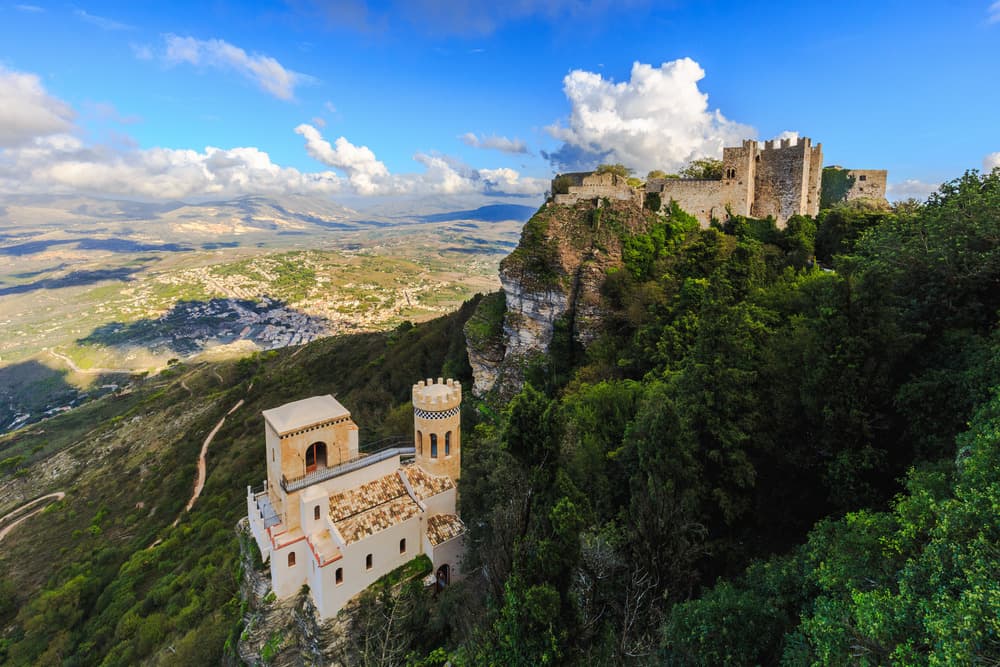
The winding road leading to the village already offers breathtaking vistas, with views of Trapani and the San Vito Lo Capo peninsula below, the Aegadian Islands offshore and on clear days Cape Bon in Tunisia. As soon as you enter Erice, you seem disconnected, as if transported to the past. Stone and ruins are omnipresent, attesting to the remarkable history of the city built by Eryx. The ancient Cyclopean walls take pride of place, having been erected by the Elimi, Phoenicians and Carthaginians as a first line of defense. Then, the winding streets, churches and old palazzos such as Palazzo Burgarella, Palazzo Ventimiglia, etc., continue the sense of dépaysement. To the north, the former Quartiere spagnolo reveals itself upon passing through the Spada and Carmine gates. To the southeast, the Castello di Venere fortress built by the Normans in the 12th century overlooks the Roman temple of Venere Ericina. Elsewhere, the Vito Carvini municipal library, the Pepoli castle dating from the 19th century, not forgetting the Tower of Balio, also await your visit.
The city of a hundred churches
Religion and the Church, which held great importance in Erice's past, are the origin of striking monuments. The mother church Duomo Dell'Assunta located on Piazza Matrice stands out for its exterior portal of Catalan inspiration and its dome with the appearance of a breast. The Chiesa di san Pietro created in 1365, was rehabilitated in a Borromini spirit in 1745. Its Baroque-style portal is equally fascinating. Finally, there is the Chiesa di San Giovanni Battista whose first plan dates from the 12th century, which boasts an ogival portal with multiple rings.
Craftsmanship, a heritage
The ironwork tradition in Erice is centuries-old. Its golden age dates back to the 16th and 17th centuries, when the sector formed one of the city's most influential guilds. Notice it—you can see some old wrought iron objects in both the castles and churches of the village. Carpet weaving is another ancestral activity in Erice: against a light background, local artisans create an interlacing of colored fabrics to produce a series of forms, ranging from geometric designs to Arabesque.
On the gastronomic side, local pastry chefs inherited delicious recipes developed by the former nuns of San Carlo and Santa Teresa. Take advantage of your time in Erice to taste local genoise, mustazzoli, bonbons riposto, carême or aromatic biscuits. The Ettore Majorana Scientific Culture Center periodically organizes traditional pastry-making workshops if you wish to learn more about the preparation and history of these delectable treats.
Climate
Erice experiences a Mediterranean climate of the Csa type according to the Köppen-Geiger classification, characterized by hot, dry summers. The region has an average annual temperature of 17.9°C. Average annual precipitation is 595.4 mm.
The journey to Erice passes through the city of Trapani from which AST company buses and the cable car depart.
If you're driving, you have a choice between two winding roads: Strada Provinciale 31 or SP3 depending on your vehicle type. The ascent takes approximately half an hour.
If you prefer the cable car, the journey takes 10 minutes. It's the best option to enjoy the region's panoramas. The service is accessible Monday 1 PM to 8 PM, Tuesday to Friday 8 AM to 8 PM, Saturday 9 AM to 9 PM and Sunday 10 AM to 8 PM. The departure station is located at the corner of Via Capua on Strada Provinciale 31. Disembarkation takes place near the Trapani Gate, close to Erice's walls.
Erice being quite small, barely 300 m wide but with considerable slopes, walking is the best way to explore the village.
What to Do in Erice?
Stroll through the charming palazzos
Admire the ancient architecture of the churches
Discover the region's artisanal traditions
Taste local pastries
Immerse yourself in the history and culture of the village at the Ettore Majorana Scientific Culture Center, etc.
Want to discover this destination?
Our local advisors design your tailor-made trip.