Otranto
Otranto
A medieval port at the southeastern tip of Italy, Otranto combines a legendary cathedral, a mosaic of 600,000 tiles, and the turquoise beaches of Salento.
Otranto, despite a tumultuous past that has left indelible marks—a striking cathedral holds part of its sorrowful memory—emerges as a charming seaside town in the Salento region.
History
The earliest inhabitants of Otranto date back to prehistoric times. When Magna Graecia conquered southern Italy in antiquity, Otranto included, the city became an important merchant port between East and West. From the Middle Ages through the early Renaissance, it served as the gateway and hub for commerce in the Italian peninsula's southern region.
After successive occupation by the Byzantines, Normans, Angevins, and Aragonese, Otranto fell into the hands of the Turks in 1480. They sought to convert the inhabitants to Islam, and those who refused were killed. 800 men perished in this infamous massacre. Their relics were placed within the cathedral of Otranto.
Otranto Today
In Otranto, whitewashed facades line the turquoise waters of the Adriatic Sea, while above, centuries-old ramparts fiercely preserve the historic heart of the city.
Discovering a Well-Kept Memory
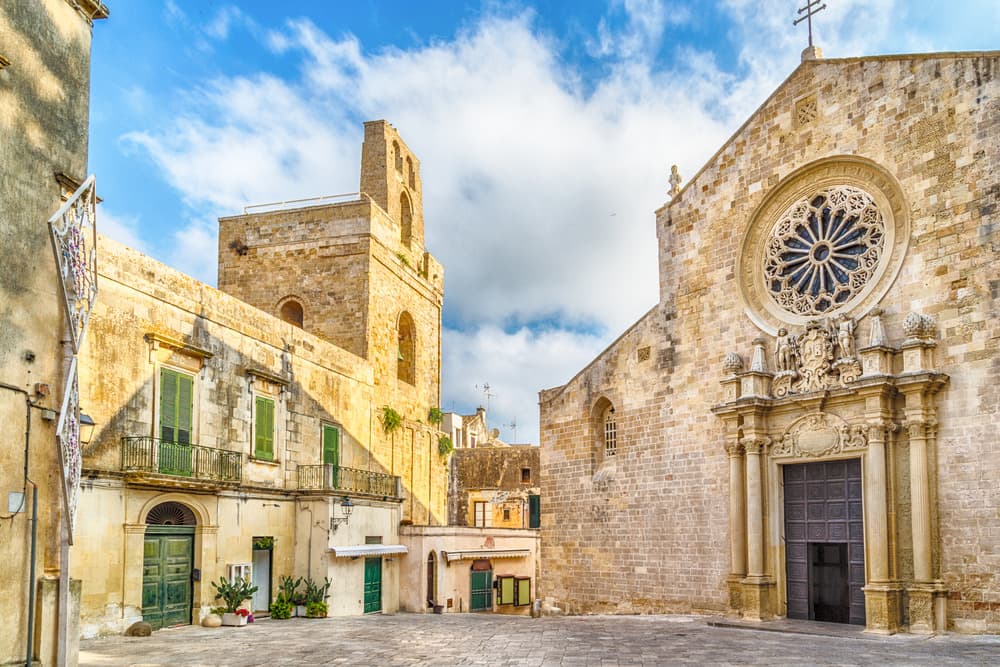
The ramparts encircling the historic center of Otranto date to the era of the Messapians, approximately eight centuries before our time. These were fortified over the centuries to defend against dangers from the sea. The monumental Porta Terra, followed by the Torre Alfonsina, constitutes the main entrance to the old town. Inside, a maze of narrow staircases leads you to squares or streets with an atmosphere frozen in time. Thus, around an unexpected corner, you'll discover the duomo, which preserves the skulls of the 800 martyrs.
The cathedral of Otranto was built by the Normans in the 11th century. Within it, in a display case behind the altar, lie the relics of the victims of the Turkish massacre. But its appeal extends far beyond this. The monk Pantaleone left it with a beautiful medieval mosaic floor composed of nearly 600,000 limestone tiles. Near the cathedral, the Museo Diocesano showcases masterpieces from the locality, including some pieces of the mosaic. More modest in scale, the Byzantine church of Chiesa di San Pietro also contains treasures, such as its impressive frescoes.
Another historic monument, the castle of Otranto, was founded in the 15th century. The building underwent several alterations to form a cohesive ensemble with the ramparts of the old town. Writer Horace Walpole drew inspiration from it to write one of Europe's earliest Gothic novels, published in 1764: "The Castle of Otranto."
Beach Pleasures Await
You don't need to travel far to enjoy beach pleasures in Otranto. The town boasts a beautiful beach at its heart. At first glance, the carefully arranged parasols along the edge of turquoise waters give this small bay a postcard-perfect appearance.
If you prefer untamed nature, head toward Porto Badisco, about a dozen kilometers from Otranto. The path leading to the site already offers striking views. Upon arriving in the bay, admire the landscape of this isolated cove nestled in a rocky embrace. It's an excellent spot for diving. According to the poet Virgil, this was Aeneas's first hiding place in Italy when he fled Troy. Furthermore, take advantage of your escape to this locality to discover the local culinary tradition of sea urchins!
Local Crafts as Souvenirs
The local craft tradition enjoys great success among the many visitors who set foot in Otranto each year. A vast catalog of artifacts, crafted from a range of natural materials, awaits you in the town's small workshops and boutiques. Let yourself be charmed by beautiful mosaics inspired by the floor of Otranto's cathedral, wicker baskets, lucky bell charms, or items made from linen.
Climate
Otranto benefits from a Mediterranean climate characterized by a hot, dry summer season and relatively mild winters. The coldest temperatures occur in January, with an average of 9°C, while August is the warmest month, with an average temperature of 24.7°C. As for rainfall, autumn and winter are the most affected seasons. Otranto averages 626 mm of rain per year.
Travel to Otranto typically passes through Lecce. The national road 16 Adriatica Lecce-Maglie-Otrante is the main highway serving the city. Various provincial roads cross it, namely: the SP87 coastal Otranto-Porto Badisco-Santa Cesarea Terme, the SP358 Uggiano la Chiesa-Otranto, the SP48 Martano-Carpignano Salentino-Otranto, the SP277 Otranto-Giurdignano, and the SP366 Otranto-San Foca-San Cataldo.
If you're driving, take the A14 toward Lecce, passing through Bari. Then merge onto the SS16 to reach Maglie and continue to Otranto. During the summer season, from mid-June through early September, buses from the "Salento in treno e bus" service run between the major destinations in Salento and make daily stops in Otranto. These also serve the Laghi Alimini and Cesarea Terme sites.
If you prefer the railway, take a train from Lecce, then a shuttle to Maglie where you'll transfer to Otranto. For your information, the station is the terminus of Ferrovie del Sud Est and the Lecce-Otranto line.
Otranto's seaside can be explored on foot or by bicycle. Due to the more or less narrow streets, using a car is not recommended. Similarly, for the historic center of the town with its winding staircases, it's best to walk to appreciate all its corners.
What to Do in Otranto?
Wander through the streets and staircases of the old town
Pay homage to the martyrs within Otranto's cathedral
Sunbathe on the beach
Go diving at the Porto Badisco site
Discover the art of mosaic-making with local artisans, etc.
Want to discover this destination?
Our local advisors design your tailor-made trip.