Portovenere
Portovenere
A colorful Ligurian village with UNESCO status, Portovenere closes the Poets' Gulf facing the islands of Palmaria, Tino and Tinetto. Genoese heritage, Lord Byron's caves and excursions to Cinque Terre.
In the northwest of the Italian peninsula, the coastal town of Porto Venere comes alive with summer tourism. Let's draw back the curtain on the destination's highlights.
Cradling the Gulf of Spezia, Porto Venere's shoreline extends deep into the sea. Relatively quiet in winter but cheerful and vibrant in summer, this resort destination offers plenty to captivate visitors. The Genoese once coveted its maritime port, disputing it repeatedly with the Marquises of Pisa. Lord Byron retreated into its rocky caves to meditate in peace and compose his poems. To this day, Porto Venere continues to dazzle with the quality of its beaches, the richness of its military heritage and the charm of its Franciscan convents. Don't waste a moment in booking your flight to Porto Venere, the jewel of the Ligurian coast.
A Matter of History
The site's name first appeared in manuscripts in 150 A.D. It is reasonable to suppose, however, that the Ligurians landed on the Spezia coast many centuries before this date. They likely lived off the bounty of fishing. The Latin origin of the place name—Portus Veneris, which can literally be translated as "Port of Venus"—proves that the site was once a Roman trading post.
After the fall of the Roman Empire, Porto Venere fell under the control of the Lords of Vezzano, before becoming a Genoese possession around the mid-twelfth century. The Republic of Genoa deemed the port favorable for maritime commerce and envisioned establishing a strategic naval base there to support its ambitions of conquest. Unprecedented architectural development followed: watchtowers, citadels and fortified houses lined the coast to protect inhabitants from attackers. The Castle of Doria, with its formidable crenellated walls descending to the sea, is the finest example of this military architecture.
Unfortunately, these defensive achievements proved futile, unable to prevent the France of the Valois and Aragonese Spain from taking control of the city. Genoese rule definitively ended around 1790. Porto Venere came under French administration from 1805 until 1814, as part of the Department of the Apennines, before being annexed to the Kingdom of Italy in 1861. Its destiny was not to become an important military port, but it has managed to preserve vivid and enchanting testimony to its past.
Today
Once a fishing village, Porto Venere today presents itself as a fashionable seaside resort. Flattering accolades abound: first, its inscription on the UNESCO World Heritage List in 1997; then, the creation of the Porto Venere Regional Natural Park in 2001, plus endorsements from Italian Touring Club recommending the idyllic beaches of Palmaria island in its travel guide. Does this charming seaside village truly deserve such enthusiasm?
The answer is an unequivocal yes. In the nineteenth century, the destination was already frequented by painters and writers. Its wild character intrigued them: the turquoise blue of the sea, the towering cliffs, the trio of deserted islands overrun with exuberant vegetation… Dante, Shelley and George Sand loved to stay here, dazzled by the brilliant light and romantic sunsets. It is no accident that the Gulf of Spezia earned the nickname the Poets' Gulf.
The town lives essentially from seaside tourism revenues. The waterfront is lined with a parade of luxury hotels, where you can spend an unforgettable stay, whether for a romantic weekend or a honeymoon. Swimming, strolling along the port, exploring marine caves and eco-tourism in Cinque Terre are all activities to experience during your tour.
Must-See Attractions in Porto Venere
With its exceptional coastline where architecture contemplates the sea, Porto Venere offers much to see and visit on a trip to Italy.
Natural Heritage
Tino Island: San Venerio made it famous by choosing it as his hermitage. The beauty of the panorama will leave you speechless. You can admire it from afar during a boat cruise, though you cannot set foot on it as the island is under military jurisdiction.
Tinetto Island: at the south of the Poets' Gulf, this rocky islet seems to emerge from the sea's depths. A monastic community once lived there before being destroyed by the Saracens;
Palmaria Island: spanning 1.89 km², Palmaria is the largest of the three islands in the Spezia archipelago. The arrangement of marked trails, vineyards and olive groves, and the presence of an endemic gecko (Euleptes europaea) make it a hiker's paradise. For your information, Palmaria is the only island accessible to visitors. As you progress westward along the shore, nature reclaims its dominion, olive groves giving way to pines and evergreen oaks. Away from crowds, the island is a perfect refuge for releasing stress or nursing a melancholy mood.
The cave tour is particularly popular with cruise passengers. Palmaria has more than thirty caves. The most famous are the Azure Grotto and the Arpaia Grotto, near the San Pietro parish, where Lord Byron loved to retreat to dedicate himself to poetry.
One day of cruising is enough to tour the neighboring islands and caves. But two days are not too much if you wish to enjoy the sea and explore the artistic and historical treasures of the old town.
Religious Heritage
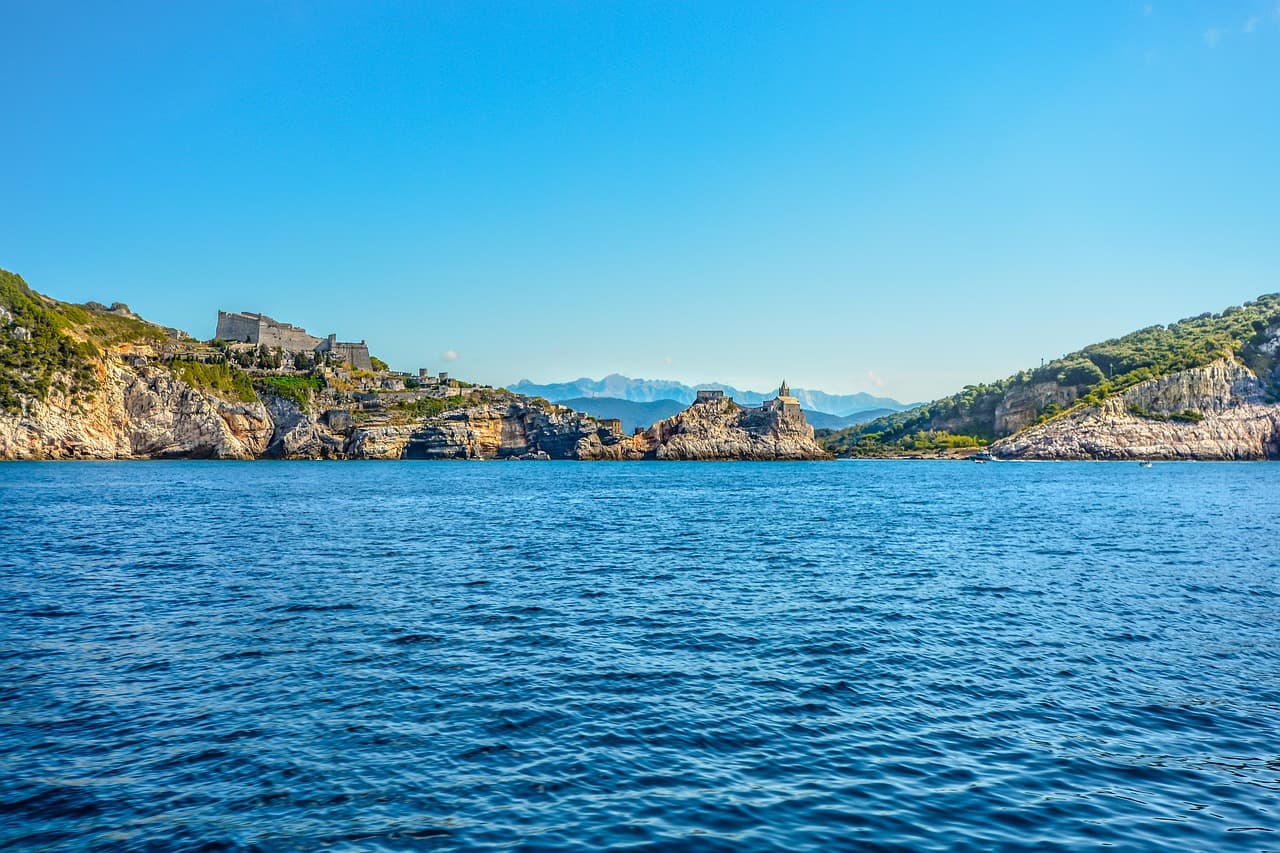
Church of Saint Peter: built on the ruins of a pagan temple where inhabitants once worshipped Venus Ericina, the Church of Saint Peter (San Pietro in Italian) stands before you, majestically overlooking the sea on a rocky promontory. Restored many times over the centuries, it nonetheless retains Roman and Byzantine elements: the rectangular layout, the circular apse and the characteristic loggia with its rows of colonnades. Tourists visit less for the architecture than for the stunning views over the Mediterranean Sea.
Church of Saint Lawrence: The parish of Saint Lawrence is likewise an ancient monument, its founding dating back to the city's conquest by the Republic of Genoa. It sits in the heart of the historic quarter, a few meters from the Castle of Doria. The facade is a fine example of Romanesque art, as evidenced by the austere decoration found only in the gabled pediment and the framing of the central door with twisted columns. The church's interior houses a painting on parchment recalling the miraculous intervention of the Virgin in 1399 to eradicate the plague. Pictorial works related to the Passion of Christ and the life of Saint Martin invite reconnection with Christian faith.
Beyond these two sanctuaries, you can continue your pilgrimage to the Church of Saint John the Baptist, adorned with Baroque altars, or the Church of Our Lady of Grace, with a ceiling covered in frescoes representative of the Genoese Baroque school, before finishing at the Abbey of Saint Venerio, open to visitors during the feast of the patron saint on September 13.
Museums and Monuments
The Castle of Doria: the magnificent castle overlooks the town from atop a cliff. The exact date of the manor's foundation is unknown. What is certain is that it was once the property of the Doria family, who played a leading role in Genoese political history. It bears witness to the golden age of Genoese princes who ruled all of Liguria from the twelfth century to the late eighteenth century. Visitors will enjoy an unobstructed view over the town and the San Pietro church.
When to Visit Porto Venere?
The seaside resort of Porto Venere enjoys a mild Mediterranean climate. Summers are hot and sunny, while winters are cool. Even in January, the coldest month of the year, temperatures do not drop below 10°C. September is the ideal period to visit the town and enjoy outdoor activities. This will allow you to avoid the summer crowds of July and August. However, autumn is not recommended due to heavy and repeated rainfall.
The best way to reach Porto Venere is by boat. Many ferries depart daily from the port of La Spezia or from Cinque Terre.
It is also possible to take a bus for €3 from surrounding towns. However, the winding nature of the road may cause some discomfort if you are prone to motion sickness.
Must-Do Activities…
sunbathe on the sunny beaches of the Spezia Gulf;
from the Church of Saint Peter, enjoy a panoramic view over the Poets' Gulf;
spend a moment of contemplation in the San Lorenzo church;
discover the local atmosphere during the White Virgin festival;
take a boat cruise to approach the three islands;
explore the famous marine caves;
visit the picturesque villages of Cinque Terre;
taste local produce and specialties.
Want to discover this destination?
Our local advisors design your tailor-made trip.