Lecce
Lecce
Lecce, nicknamed the Florence of the South, reveals in the heart of Puglia an exuberant baroque heritage, Salento beaches and still-preserved gastronomy.
Lecce is a charming art and museum city in southern Italie, in the heart of the Puglia region. Here's a look at what makes this destination special.
Introduction
Looking for a cultural getaway in Italie without the crowds of Genoa or Florence? Visiting Lecce is an excellent idea. Blessed with a gentle Mediterranean climate, this city in southeastern Puglia has earned a reputation among travelers for its architectural charm, blending Greco-Roman influences with baroque and Renaissance styles. Beyond the stunning Basilica of Santa Croce, which stands as an iconic landmark, a succession of churches, palaces and medieval towers recall the golden age when Lecce was one of the most important economic centers of the Kingdom of Naples. Its nickname, "the Florence of the South," says it all. Two days are barely enough to explore all the city's artistic treasures. Head to Lecce and discover Italie's Puglia region in all its splendor.
A Glimpse of History
The origins of this site stretch back to legendary times. Lecce is believed to have been founded around 350 or 400 BCE, predating the Trojan War recounted in Homer's epics.
The city's first name was Sybar. Conquered by the Romans, it was renamed Lupiae. This name would change again to Litium and Lictia. Falling into the hands of the Saracens around 840 and later dominated by the Byzantines, Lecce only experienced genuine political organization in the mid-11th century, when the House of Hauteville conquered Sicily and the region.
Lecce then became part of the Kingdom of Naples. After the Battle of Lepanto in 1571, the Ottoman fleet was decisively defeated and ceased to be a threat to the coastal towns of Salento. From the 17th to the 18th century, the city enjoyed a long period of peace and prosperity. Art, commerce and sculpture flourished spectacularly. A flourishing of churches, monasteries and palatial residences reshaped the city in baroque style. One dark chapter: a plague epidemic decimated thousands of inhabitants in 1656. The outbreak ended following a miraculous intervention by Saint Oronzo. In gratitude, a column dedicated to this benefactor was erected in the square that bears his name.
From its founding in ancient Greece through its annexation by the Kingdom of Italie in 1861, Lecce experienced numerous upheavals and popular revolts. The MUST Museum faithfully preserves this memory, should you wish to journey through time.
Today
There are museum cities that have passed through the ages without showing a single wrinkle. Lecce is the perfect example: well into the 21st century, it has preserved a flawless medieval and Renaissance character. Though lacking direct maritime access, it sits near the Salento peninsula, surrounded by two small bodies of water: the Adriatic Sea and the Ionian Sea. This makes it an ideal destination for art and architecture enthusiasts, while equally satisfying those craving sunshine, beaches and leisurely Mediterranean living.
As the provincial capital of Lecce, the city has a population of around 95,766 inhabitants (2015). More than 900,000 tourists visited the area in 2015, the majority Italian nationals. Foreign visitation, still numerically modest, consists largely of retired German and English-speaking visitors. Regarded as a cradle of baroque architecture, Lecce stands as a flagship of historical and artistic tourism in southern Italie.
Points of Interest
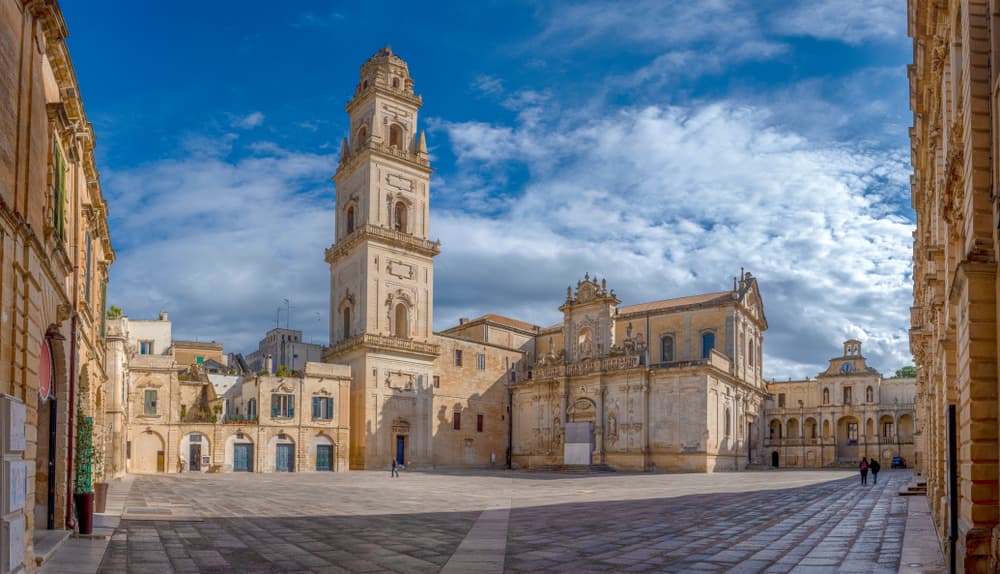
Vacationers particularly enjoy strolling around Piazza del Duomo, the historic heart of the city.
Religious Heritage
The Basilica of Santa Croce: Built on land once occupied by Jews who fled persecution under King Ferdinand of Aragon, this monumental edifice is the city's number-one attraction. The church's cornerstone was laid in 1549, though most of the construction was completed during the 17th century. Linger over its exuberant façade: the large rose window, the three portals framed by columns and entablatures, along with animal figures adorning the balustrade, all announce a taste for ostentation characteristic of baroque. Three great architects collaborated on its construction. Art lovers will delight in discovering works from the Italian school inside: The Adoration of the Shepherds, Saint Anthony of Padua, The Trinity, and more. Completed after 146 years, the Basilica of Santa Croce is undoubtedly the finest achievement of local baroque art (barocco leccese).
The Celestines Palace: Standing beside the basilica, the Celestines Palace is another jewel of 17th-century baroque art. Its design was drawn by Giuseppe Zimbalo, a master of barocco leccese. It now houses the offices of the Department of Lecce.
The Basilica of Saint John the Baptist: Completed during the first half of the 18th century, the Basilica of Saint John the Baptist is another exceptional monument. It originally served as a place of worship and residence for Dominican friars from 1388 onward. If the church's façade is breathtakingly beautiful, the interior is equally impressive. The choir's backdrop stands out with numerous religiously inspired paintings: the Nativity, the Preaching of Saint John, the Assumption of Mary, the Crucifix, and more.
The Cathedral of Lecce: Dominating Piazza del Duomo, the Cathedral of Lecce is one of the major cathedrals in southern Italie. A first structure existed as early as the 12th century before being completely redesigned in baroque style by architect Giuseppe Zimbalo in 1659. Study the imposing high altar and twelve other altars enriched with paintings from the Lecce school. The nighttime visit is by far the best, when the church's bell tower, which rises to 70 meters high, illuminates the entire city.
Beyond the Basilica of Santa Croce, the Cathedral of Lecce and the Basilica of Saint John the Baptist, other equally magnificent churches await travelers at every corner: the Church of Santa Chiara, the Church of San Matteo, the Church of the Carmine, the Church of San Francesco della Scarpa, marking where Saint Francis of Assisi stayed during his visit to the city, and the Church of Saint Irene, dedicated to Lecce's first patroness.
Museums and Monuments
The Roman Amphitheater: Built between the 1st and 2nd centuries CE, the ancient Roman theater will captivate history enthusiasts on Piazza Sant'Oronzo. Despite its ruined state, the circular arena, seating tiers and outer walls remain clearly visible. After the fall of the Roman Empire, the building was buried underground before being excavated by archaeologist Cosimo De Giorgi in the 20th century. The amphitheater houses a small museum (Museo Teatro Romano) that shouldn't be missed.
The Statue of Saint Oronzo: Just a stone's throw away, admire the statue of Saint Oronzo, Lecce's patron saint, who earned this title after performing a miraculous healing in 1656. For reference, this statue was a gift from the people of Brindisi.
The Castle of Charles V: Continue your visit by paying homage to the Castle of Charles V. Built on the ruins of an old Norman fort, the castle asserts its defensive purpose through its watchtower, four pointed bastions and artillery cannons. A striking testament to medieval Italie, when Puglia was vulnerable to Turkish raids and invasions.
The Papier-Mâché Museum: The Castle of Charles V houses the Papier-Mâché Museum within its walls. This place is genuinely worth the visit. Local artisans gather scraps of paper and, combining them with stone, straw and a bit of plaster, create exceptional artistic pieces.
The Faggiano Museum: Opened in April 2008, this private establishment took on an archaeological mission by chance. When Luciano, the property owner, broke through the floor to renovate the plumbing, he didn't expect to discover antiquities. What followed were excavation works lasting up to seven years, which unearthed a fountain, a grain storage cellar, burials, cisterns, Templar artifacts and numerous other prehistoric finds. The Faggiano family funded the work themselves. Luciano and his three sons personally led the excavation campaign, suddenly finding themselves in the roles of anthropologists. This family property, which served as a Templar warehouse from the year 1000 to 1200 before being occupied until the late 16th century by a Franciscan convent, is a genuine time machine. Two thousand years of history are read, heard and told in this small museum!
Nearby Attractions
To enjoy the pleasures of the sea, you'll need to venture outside the city center and head down to Otranto. After a 38-minute drive, the Adriatic coastline, bordered by bays, coves and impressive cliffs, reveals itself to travelers. If children are joining you, the family can organize an eco-tourism circuit in the San Cataldo Natural Reserve. Founded in 1677, this 28-hectare protected area supports a vast population of foxes, weasels and hedgehogs, along with endemic Mediterranean plants.
If you stay longer than a day, set off for the Salento seaside resort, whose sandy beaches, washed by the Ionian Sea, boast some of the most beautiful views in Puglia. Singles will find nightlife at the clubs in Baia Verde or Porto Cesareo, while vacationing families will discover plenty of pleasures at Torre dell Orso, Baia dei Turchi, or Alimini Beach.
European citizens can fly into Brindisi Airport or Bari Airport. The former is closest: it's just a half-hour drive from the city. The latter is about two hours away.
A flight to Brindisi from Paris typically takes 2 hours and 30 minutes, not counting layovers. The most active carriers on this route are Alitalia, Air France and Ryanair.
Upon exiting the airport, simply rent a shuttle to reach Lecce's city center. The fare costs between 7 and 8 €.
When to Visit?
Lecce enjoys a quintessential Mediterranean climate. Weather is beautiful and warm in summer (18°C to 26°C), an ideal period for swimmers and divers. However, the crowds of July and August visitors that descend on the city can spoil your stay.
Winters are not recommended for visiting either. Although temperatures are quite mild, rarely dropping below 10°C (no risk of frost or snow), rainfall can be a significant concern.
To enjoy a peaceful vacation in Lecce, plan your visit for May, June or September. By early May, you can already venture out without a sweater. However, bring rain gear if you're traveling outside summer season.
You'll Love…
Photographing the famous façade of the Basilica of Santa Croce;
Admiring the beautiful architectural ensembles of Piazza del Duomo;
Enjoying seaside relaxation in Otranto, a beach resort near Lecce**;**
Watching the moving videos at the Jewish Museum Palazzo Taurino;
Tasting the local gastronomy
Want to discover this destination?
Our local advisors design your tailor-made trip.