Matera
Matera
Troglodyte dwellings, rupestrian churches and UNESCO heritage: Matera reveals in Basilicata one of Europe's most singular urban landscapes.
A city in southern Italy, Matera captivates visitors from around the world with its « sassi », troglodyte dwellings carved directly from the rock. Here's an overview of what makes this destination unmissable.
Introduction
Atypical, unique and authentic, Matera unveils to travelers a hidden facet of Italy. If you're seeking to venture beyond the beaten path—to discover something more than Michelangelo's masterpieces, ancient statuary, and charming squares filled with musicians and fountains—no other destination could suit your taste better. It would be no exaggeration to say that this southern Italian city, where people once inhabited rocky caves alongside livestock, was once considered Italy's shame. In the 1990s, tourism transformed this impoverished and forsaken town of Basilicata into a globally renowned destination; the restored caves now offer hotel and restaurant services set within a prehistoric backdrop. Book your flight to Matera today and enjoy an extraordinary escape in southern Italy.
A Brief History
Traces of human occupation in the region date back to the Paleolithic era, roughly 10,000 years before the Common Era. The founder of Matera was Lucius Caecilius Metellus, a Roman dictator and consul who, having emerged victorious from the First Punic War, established Roman dominion over Sicily. The conquest of the city—then known as Matheola—took place around 251 BC.
After years of battles in which Lombards, Byzantines, and Arabs took turns ruling, Matera had become by the 15th century a dependent territory of the House of Aragon. It was granted as a barony to the Monterano family. Rebellion soon stirred when Count Giovanni Carlo Monterano was perceived as arrogant and a cruel ruler. He was accused of financing his lavish lifestyle at the people's expense through exorbitant taxation. His death in 1514 was decided by mutual agreement between the people and nobility of the time.
Clearly, the precarious conditions in which the peasant masses lived reflected the injustice and oppression of the feudal regime. Until the 20th century, villagers had only rupestrian constructions on mountainsides as shelter. They had to share their dwellings with animals, separated only by crude partitions. There was no running water, sanitation, or electricity. The Sassi of Matera were regarded as the territory of the disadvantaged and forgotten, in stark contrast to prosperous Italy.
In the early 1950s, the Italian government launched an urban development program in Matera. The aim was to relocate villagers to decent housing that met modern hygiene and sanitation standards. The ancient quarter of Matera nearly fell into abandonment. Thanks to the dedication of its inhabitants, the « Sassi » were restored, preserving their traditional character while incorporating modern comforts.
The Modern City
Matera gained international prominence in 1993 when UNESCO inscribed it on the World Heritage list. Its designation as « European Capital of Culture » in 2019 definitively confirmed its embrace of international tourism. Visitors are immersed in a uniquely traditional atmosphere found nowhere else in the world.
Due to its primordial and picturesque setting, Matera has been the backdrop for numerous film productions. The « sassi » have served as the setting for Pier Paolo Pasolini's The Gospel According to St. Matthew, the acclaimed 2017 film Wonder Woman, and roughly a dozen other productions.
Points of Interest
A stay in Matera is an opportunity to explore extraordinary rupestrian sites.
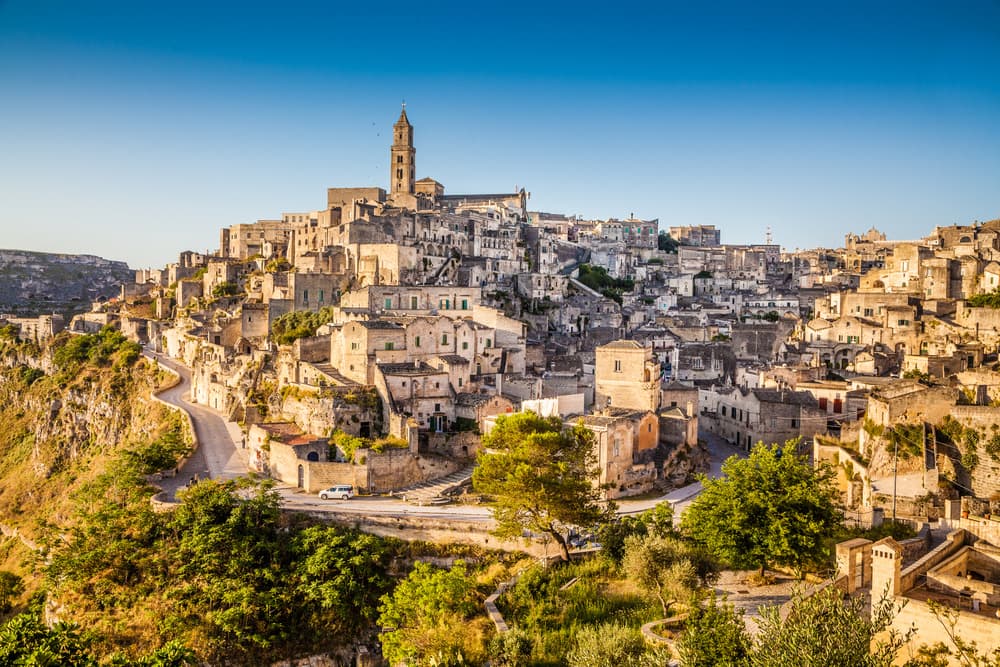
The « Sassi »: Distinctive Troglodyte Dwellings
The notion that people once occupied dwellings carved directly into stone seems inconceivable. History tells us that populations sought refuge inside these limestone caves to escape raids by Saracens, notorious for their reprisals against Christians. Later, Byzantine monks settled there. The caves were transformed into chapels, and walls were adorned with luminous frescoes.
The architecture of these troglodyte homes is remarkably simple: a whitewashed façade pierced by a door and window. Houses are stacked one above another, threaded with staircases and narrow lanes, arranged around a large communal courtyard. Tragic geography of poverty, malnutrition and waste, the Sassi were inhabited by large families. A household might support five or six children. There was typically only one large room serving multiple purposes: eating, living, and working. Drawers from furniture served as cradles for infants.
The Sassi of Matera constitute a spectacular example of prehistoric mountainside dwellings. In this respect, Matera presents itself as a sister city to Lalibela, the Black Jerusalem of Ethiopia. According to archaeologists, the « sassi » rank among Italy's oldest dwellings, and perhaps among the world's.
Historical Heritage
Tramontano Castle: Erected atop a rocky outcrop—Lapillo Hill—the Tramontano fortress is unquestionably the city's most important attraction after the historic cave houses. Count Gian Carlo Tramontano had it built as his family estate. It features a splendid landscaped park where children can roam freely. Yet, judging by its strategic location, central keep, and crenellated round towers flanking the walls, the castle served primarily as a defensive stronghold.
Construction began in 1501, but the project remained unfinished after Matera's lord died in 1514 as a result of popular vendetta. For this undertaking, he committed a considerable sum of 25,000 ducats, paying the architect from public funds—a decision the people could not abide. The count was assassinated, but his wife was granted safe passage.
Would you like a guided tour of Tramontano Castle to immerse yourself in the daily life of 16th-century aristocrats and discover feudal Italy as though reading from an open book? Undergoing restoration, the castle has retained its original Aragonese architecture.
Religious Heritage
The Duomo, or Cathedral of Matera: Built atop the Civita, the old cathedral of Matera has existed for over 800 years. Capture in photographs its dazzling Vaglia stone façade, where Romanesque art predominates. The sixteen-branch rose window will surely captivate your gaze, as will the Archangel Michael crowning the window. The four statues of Saint Peter, Saint Paul, Saint Eustace, and Saint Theophist guarding the church entrance are equally noteworthy. Inside, art enthusiasts will delight in a collection of Byzantine works, including a Last Judgment dating from the 14th century and the Madonna della Bruna with the Child's Two-Fingered Blessing, both produced by Rinaldo da Taranto. Beyond the frescoes, the luxuriously decorated vault alone merits a visit. An absolute must during your stay in Matera!
Beyond this magnificent Romanesque cathedral, Matera features two other churches worth exploring: San Pietro Caveoso and San Pietro Barisano. These are curious rupestrian structures, carved directly from the rock. San Pietro Barisano is the city's largest rupestrian monument.
Monuments and Museums
The city boasts several museums of note. The Palazzo Lanfranchi, home to the Museum of Modern Art of Basilicata, will delight enthusiasts of sacred objects, photographs, contemporary pieces, and anthropological finds. By contrast, the Museum of Peasant Culture offers a journey steeped in history and tradition, while Casa Noha and Casa Grotta emphasize prehistoric dwelling models.
When to Visit?
Wondering when is the best time to visit this incomparable city? For your information, winter is best avoided. From December to March, temperatures easily dip below 8°C; the altitude (401 meters) is largely responsible. Nothing prevents you from visiting in autumn or summer, however. From early April onward, the cold is relatively bearable. That said, rain gear is advisable if you travel to Matera in April, May, or October.
The nearest airport is in Bari. Also known as « Bari-Palese Macchie Airport » or « Karol Wojtyła Airport », it records the highest passenger traffic in the Apulia region. The simplest way to reach Matera is therefore to take a flight to Bari. Multiple airlines, including Ryanair, Volotea, easyJet, and Lufthansa, operate connections between Bari and major European destinations.
Once at the airport, simply hail a taxi to reach Matera in about one hour and ten minutes. The fare will run between €100 and €130. Note that bus services operate from major Italian cities, should you plan to first visit Florence, Milan, or Taranto before making your way to the city of « sassi ».
You'll Love…
- strolling through the historic « sassi » district;
- indulging in photo sessions throughout the old town;
- renting an atypical room in one of these traditional dwellings;
- taking in Matera's remarkable monuments;
- enjoying a spiritual walk through Matera's cathedral;
- visiting the local market.
Want to discover this destination?
Our local advisors design your tailor-made trip.