Parma
Parma
The discreet capital of Emilia-Romagna, Parma combines ducal heritage, opera and UNESCO gastronomy. Our complete guide for an Italian weekend off the beaten path.
Readers of Stendhal cherish its memory through The Charterhouse of Parma, while Verdi's La Traviata still echoes in opera houses around the world. Parma and art share an unfinished story, punctuated by delicious interludes flavored with Parmigiano.
History of Parma
The Parma region, originally inhabited by the Etruscans and later by the Gallic Boii in the 4th century BCE, fell into Roman hands in 183 BCE. The Byzantines, followed by the Lombards, subsequently conquered the city. Parma attained the status of a free commune in the 12th century, before being conquered again first by the Visconti, then by the Sforza, and finally by the papacy around 1513 under the reign of Julius II. The Duchy of Parma and Piacenza was established at the initiative of Pope Paul III Farnese in 1545, an imperial fief later granted to Pier Luigi. The Farnese family administered the region until 1731, when the Bourbons arrived.
Parma, Birthplace of Artists
In the 18th century, the Enlightenment movement influenced the development of cultural policies within the city. Parma, whose architecture grew more magnificent over time, simultaneously became a haven for artists. Among other illustrious figures linked to the city, you'll find conductor Arturo Toscanini (1867–1957), who studied cello at the Regia Scuola di Musica in Parma, and opera composer Giuseppe Verdi (1813–1901).
Parma Today is…
The Italian Dolce Vita
Unlike its sisters Milan and Bologna, the city remains discreet and unpretentious. Yet it has much to boast about, with its elegant architecture, cultural heritage, and particularly its gastronomy. The food culture of its region, Emilia-Romagna, is an art form and a rich variety of protected designation products. The aperitivo has become a true institution, but above all a lifestyle marked by sharing and refinement.
However, Parmesan sophistication extends far beyond the dinner table. The atmosphere throughout the city is serene and extends to its surroundings. Slightly removed from the city, at the foot of the Emilian hills, the thermal springs of Tabiano, Monticelli, Sant'Andrea Bagni, and Salsomaggiore will fulfill your desires for peace and wellness. And since fashion is an integral part of Italian Dolce Vita, Parma also has its shopping destination for lovers of fine things. The Strada della Repubblica in its historic quarter houses shoe boutiques, renowned perfumeries such as Acqua di Parma, ready-to-wear stores, antique shops, and jewelry stores, among others.
A Pedestrian Historic Center
Narrow streets wind through the historic center of Parma. Though cars are permitted in many places, luxury vehicles are rarely seen. Residents prefer to walk or cycle instead. The neighborhood is consequently pleasant to visit, less polluted, and quieter.
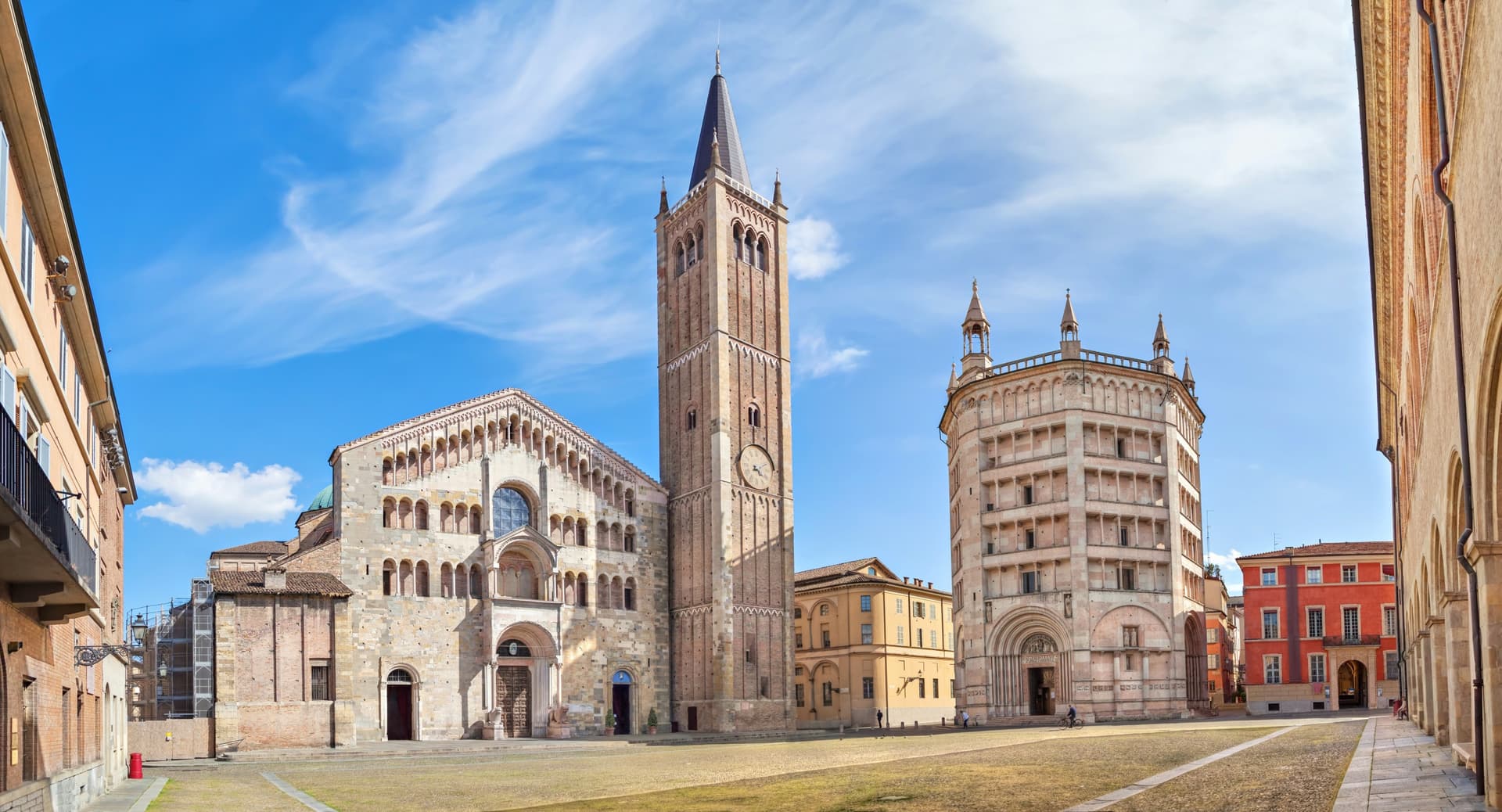
As for architecture, several historic buildings are worth a visit, including the Duomo with Romanesque inspiration, the rose-marble baptistry, the complex of the San Giovanni Evangelista church whose dome was decorated by Correggio, the monumental Teatro Farnese and the Palazzo dei Governatori situated on Piazza Garibaldi.
Gastronomy in a Creative City
In Parma, the art of "fine dining" is cultivated—an attitude rewarded by the title of "City of Gastronomy" within the UNESCO Creative Cities Network. Forget fast food and opt instead for trattorias, where menus are affordable, service is straightforward, and the atmosphere is familial. You'll find several excellent tables along Strada Luigi Carlo Farini.
Parmesan cooks take pride in using quality ingredients and offering refined, flavorful, and healthy cuisine to diners. Local Parmigiano Reggiano will delight your palate. This world-renowned cheese appears in nearly all traditional and contemporary recipes. In Parma, it's enjoyed with a touch of honey as an aperitivo. Ham also stands as a flagship of local gastronomy. Take advantage of your stay in Parma to taste the famous prosciutto di Parma. After 38 months of maturation, this delicious cured meat practically melts in your mouth.
Art Rooted in Land and Popular Culture
Parma's opera scene brings together not only virtuosos of Italian music, but also a fine collection of monuments. As a prime example, the Auditorium Niccolò Paganini showcases a splendid recovery of industrial archaeology. Architect Renzo Piano created the venue within the former Eridania sugar refinery in 2001. Acoustic properties were central to honoring the memory of composer Niccolò Paganini.
Much older, the Teatro Regio was built between 1821 and 1829 at the request of Parma's duchess Marie Louise of Austria. The building adopts a neoclassical style, enhanced inside by a prestigious chandelier. It was within these walls that Italian melodrama was born. The Regio di Parma, classified as "di tradizione," welcomes a discerning and demanding audience. The Verdi Festival, which honors Giuseppe Verdi, takes place there each autumn. Speaking of Verdi, a monument dedicated to him stands near the Teatro Regio. To learn more about this Romantic composer's life, an audiovisual exhibition has been installed in his birthplace in Roncole.
To continue your journey tracing Parma's great musicians, visit the birthplace of Arturo Toscanini, the conductor who created La Bohème in 1896 and later became the musical director of Milan's La Scala.
Climate
Its position in Emilia-Romagna gives Parma a climate somewhere between Mediterranean and continental. The Apennines shield the city from the harsh northern Italian cold.
In spring between April and June, days are sunny, with pleasant temperatures averaging between 14°C and 17°C. These rise with the arrival of summer in May and can reach 30°C. While the summer season isn't necessarily ideal for hiking, it's perfect for outdoor aperitivos. Gray skies move into Parma starting in October. In autumn, the weather cools, especially in November, which averages 10°C. Rain also arrives during this period with average precipitation of 114 mm. Finally comes winter, when temperatures rarely exceed 8°C. Snowfall is likely during this season, despite low rainfall of 40 mm in January.
The Parma train station is located about a ten-minute walk from the historic center, on the east bank of the Parma River. It welcomes roughly a hundred trains daily from central and northern Italy, as well as European lines.
Since the city's airport sees little traffic, the best option for air travel is a flight to the nearest airports—Milan, Verona, or Bologna—from which you can then take a train to Parma.
Parma is best explored on foot, given limited vehicle access, especially in the city center. Though the city's public transport network is well organized, serving most of the area, residents and tourists alike prefer to walk or rent a bike.
What to Do in Parma?
Browse the boutiques of the city's historic center
Sit down in a trattoria to discover the art of Parmesan cuisine
Attend a musical performance at the Auditorium Niccolò Paganini or the Teatro Regio
Revitalize yourself in the Salsomaggiore thermal baths
Visit Parma's Duomo, and more
Want to discover this destination?
Our local advisors design your tailor-made trip.