Perugia
Perugia
Capital of Umbria, Perugia blends Etruscan heritage, Renaissance art, and student energy. Complete guide: what to see, when to visit, where to stay.
Beyond the Porta di San Pietro, within solemn churches, winding through cobbled alleyways toward revitalized piazzas, history echoes everywhere in the capital of Umbria. Fortunately, university students from around the world are there to help Perugia unwind.
History
Perugia, formerly known as Perusia, was among the 12 Etruscan city-states. In 310 AD, it was the site of a confrontation between the Etruscans and Romans. In the 9th century, Charlemagne and Louis the Pious granted permission for the city to become papal property. Later, in the 14th and 15th centuries, rivalries between the Baglioni, Oddi, and Michelotti families led to Perugia's decline.
Perugia entered another dark period in 1520, with the beheading of its lord Gianpaolo Baglioni in Rome, on the orders of Leo X. Stripped of its major artworks by Bonaparte's army in 1797, the city was finally liberated from papal control when conquered by the Austrian army in 1849. It then became part of Piedmont alongside other Umbrian towns.
Birthplace of Italian Master Painters
Perugia gave rise to the Umbrian School of painting. Perugino trained major artists there, including Pinturicchio and Raphael, who created the upper portion of The Trinity in the Chapel of San Severo in Perugia.
Perugia Today
Welcome to a museum-city where monuments fill the air with melancholy. But mingling with its international student population, you'll find the atmosphere quickly becomes relaxed in Perugia. The piazzas, beyond their historical significance, are gathering places where good humor and conviviality thrive.
An Open-Air Museum
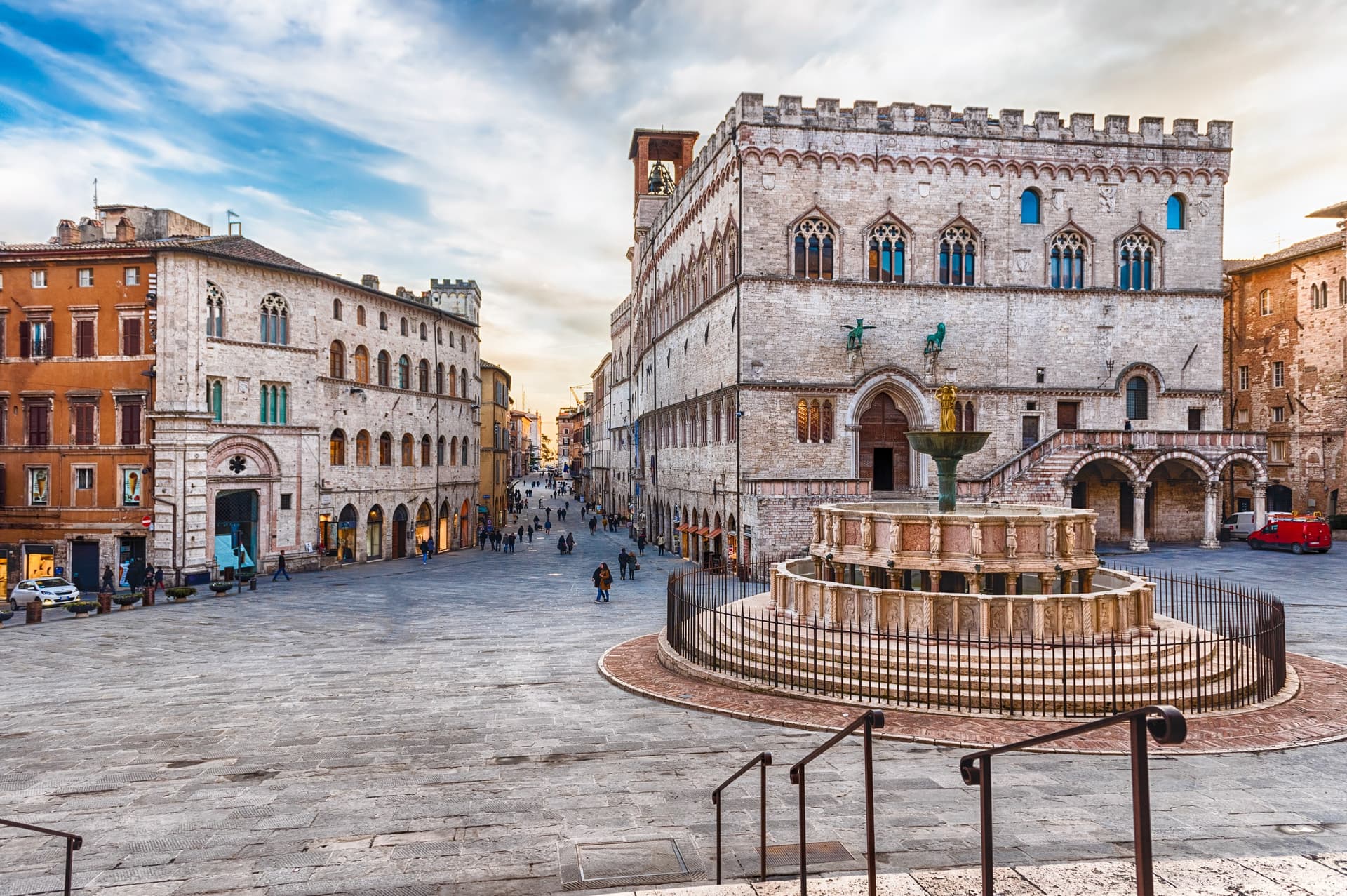
The historic center of Perugia has changed little in 400 years. Its cobbled streets and arches filtered by shadows and light transport you back to medieval times. Crossing through the Porta di San Pietro, your journey through time begins. The Basilica of San Domenico opens the way with its ancient statues and collection of local artworks. Nearby stands the former convent, now converted into the National Archaeological Museum. Next, head toward Piazza del Sopramuro, where you can admire the Palazzo del Capitano del Popolo and the old university palace.
After this introduction, delve into Perugia's "deeper" history by visiting the Rocca Paolina. Around 1540, Pope Paul III ordered the construction of a fortress above the city center to punish Perugia's citizens who contested the imposition of a new tax. You access the Rocca via the Porta Marzia. Underground galleries will lead you to forgotten corners and unsuspected markets, as well as to a contemporary exhibition center. Reaching the top of the complex, in the shade of the Carducci Garden's trees, enjoy panoramic views of the rest of the city.
University Life
The culture of study is rooted in Perugia's identity. Within its two major universities, a point of national pride, cultural experiences complement academic programs to ensure comprehensive understanding of a field of study, the Italian language, and culture in general. Founded in 1925, the University for Foreigners of Perugia is one of the oldest of its kind in Italie and has produced many notable figures such as Austrian actor Helmut Berger, American filmmaker Arthur Penn, Prince Leka of Albania, and others.
Perugia's Festive Side
On weekends, during university breaks, or simply when classes end, the peaceful Piazza Duomo transforms into a vibrant stage. As tourists gradually depart as evening falls, it's customary for students and young professionals to gather in small groups to unwind. Music fills the air, with all manner of instruments: guitar, harmonica, percussion, vocals, flute… The repertoire is vast, like the cosmopolitan community itself, ranging from folk songs to reggae, passing through Bob Dylan. The atmosphere breathes conviviality, conducive to new friendships. Some stay late on the plaza, while others continue the evening in the city's bars and clubs; nightlife venues are plentiful in Perugia!
Perugia hosts two world-class events each year. The first takes place in July and caters to music enthusiasts: the Umbria Jazz Festival. The main stage is set up in the heart of the historic center. The lineup features jazz, blues, pop, and alternative music. The festivities then continue in bars and cafés, as well as in the alleyways. The second event, scheduled around October, will delight food lovers: Eurochocolate. This festival celebrates original creations and the latest innovations from chocolate artisans. For the occasion, stands lined along the city walls offer visitors an array of gastronomic, educational, and recreational activities.
Climate
Perugia, in the Umbria region, enjoys a subtropical climate. Temperatures range from 4.2°C in January, the coldest month, to over 23°C during July. Throughout the year, the average temperature stands at 13°C. As for rainfall, precipitation averages 800 to 900 mm annually, with possible snow in winter.
By road, Perugia is accessible via three main routes: the E45 or SS 3 bis, the junction of the A6 Bettolle-Perugia motorway, and the Perugia-Ancona road.
By rail, the city is served by trains on the FCU Sansepolcro-Terni line, the RFI Foligno-Terontola line, and the Central Railway Umbria. There are multiple stations in Perugia depending on your destination: the main Perugia Fontivegge station, Perugia Ponte San Giovanni, Perugia Capitini, Perugia Silvestrini, Perugia University station, Perugia Sant'Anna station, Piscille Station, and Perugia Pallotta station.
Perugia has an airport located in the hamlet of Sant'Egidio, about twelve kilometers east of the city.
Beyond standard buses covering most of Perugia and its surroundings, a series of mechanized routes wind through the edges of the historic center and Rocca Paolina. The Perugia minimetro operates on a 4 km circuit starting from Pian di Massiano stop toward Pincetto center, from which escalators depart for the old town.
If you're driving, note that vehicle traffic is restricted in certain areas of Perugia, particularly in the center. Walking is preferable to better appreciate the city's environment.
What to Do in Perugia?
Explore the underground galleries of the Rocca Paolina
Admire the frescoes of the Chapel of San Severo in Perugia
Discover the city's university life
Attend jazz cabarets
Experience the Perugia minimetro, etc.
Want to discover this destination?
Our local advisors design your tailor-made trip.