Taranto
Taranto
An ancient Spartan colony nestled between Mar Piccolo and Mar Grande, Taranto brings together Greek ruins, an Aragonese castle, stately palazzi, and Ionian flavors.
An ancient Spartan colony, Taranto stands out among Apulia's most fascinating destinations for its Greek ruins, Aragonese castle, and stately palazzi. Here's your practical guide to Taranto.
Taranto, a two-faced Apulian city
South of Rome, Taranto is a thriving commercial port and a major shipyard. Founded in the 8th century BCE, the ancient Greek colony of Taras became the third-largest metropolis of Southern Italy. While Taranto's future lies in industrial development, an enchanting museum-town emerges when you take time to wander its historic center. Who hasn't visited Taranto without marveling at its Aragonese fortress proudly overlooking the Ionian Sea? The castle esplanade shelters Greek and Byzantine ruins. Consider the baroque treasure that is the Cathedral of Saint Cataldo. Look at the countless palazzi lining each alley, testaments to the era when Genoese, Florentine, and Angevin nobility governed the city. The National Archaeological Museum deserves a place on your itinerary too. If you've fallen for Taranto's rich heritage, you'll be even more captivated by its culinary treasures. Hotels and Michelin-starred restaurants serve cuisine based on squid, octopus, and fish, always dressed with olive oil.
History
The coastal city of Taranto, originally named Taras, enjoyed its golden age during the Hellenistic period. Tracing the city's history chronologically is a challenge. The Romans merely took Taranto from the Spartans and plundered all the colony's riches. The Byzantines, Saracens, and Normans left barely a trace. The feudal system imposed by the royal houses of Aragon, Swabia, and Anjou and the Duchy of Normandy brought little benefit to Taranto. These European princes shone more through ostentation than genuine care for their subjects. After being the most prosperous city of Magna Graecia, Taranto slipped into long decline before being reborn in the modern era as a naval and industrial power.
According to Greek writer Antiochus of Syracuse, Taranto was founded by the Parthenians in the 18th century BCE. Following the Oracle of Delphi, their leader Phalanthus journeyed to Apulia and established a new city. He named it Taras, after the son of Poseidon. Swiftly, the Greek colony gained economic and cultural importance, commanding the entire southern Italian coast. It minted its own coins: the nomos, depicting the god Taras riding a dolphin. It became a brilliant center for pottery production. Vessels with refined motifs were crafted in the city's workshops, then sold throughout Apulia. These were primarily red-clay amphorae used in funerary offering ceremonies. Artistic influence was matched by intellectual significance. Many ancient Greek thinkers, writers, poets, and diplomats hailed from Taras.
In the early 18th century, Italy fell under Bourbon rule. Taranto hosted a major naval shipyard amid conflicts with the English and Russians. The young Choderlos de Laclos perished in these clashes. In the early 1960s, the Italsider group made Taranto an important steel production and processing site. Industrial growth accelerated rapidly. Soon came oil refineries, chemical plants, and agribusiness firms.
Today
The capital of Taranto Province is the "city of two seas," the Greek Taras or Taranto, home to 198,000 inhabitants. It exemplifies an authentic destination, exactly what today's travelers seek. Continued industrial and commercial development hasn't meant turning its back on the past. The old town, dominated by its commanding castle, sits on an artificial island bordering a lagoon. The new city follows a formal urban plan with broad avenues filled with cafés, restaurants, boutiques, and tourist hotels. Generally, Italian tourist circuits overlook Taranto. Yet its illustrious Hellenistic past is, in our view, reason enough to stop here during a trip through Apulia.
Must-see attractions
Taranto is a destination with two faces. Borgo Nuovo will delight dedicated shoppers and satisfy discerning food lovers. Those seeking authenticity will gravitate toward Borgo Antico. A charming swing bridge connects the two in a striking perspective.
A stroll through the market
Take time to linger in Borgo Nuovo for gastronomic indulgence. In fine food shops, you'll find an excellent selection of wines, fish, and other agri-food specialties.
Archaeological heritage
The National Archaeological Museum of Taranto
Short on time? Skip other monuments but visit the National Archaeological Museum of Taranto or MArTA at all costs. If you're curious about Taranto's key historical dates and want to discover the world's richest collection of Greek terracotta statues, don't hesitate to enter MArTA. The museum's centerpiece, however, lies in its ceramics. Red-pattern kraters, libation bowls, fish plates, Laconian cups decorated with cetaceans—the artists' creativity is remarkable! Beyond these painted vessels, the museum holds coins and jewelry pieces.
Cultural and religious heritage
The Aragonese fortress
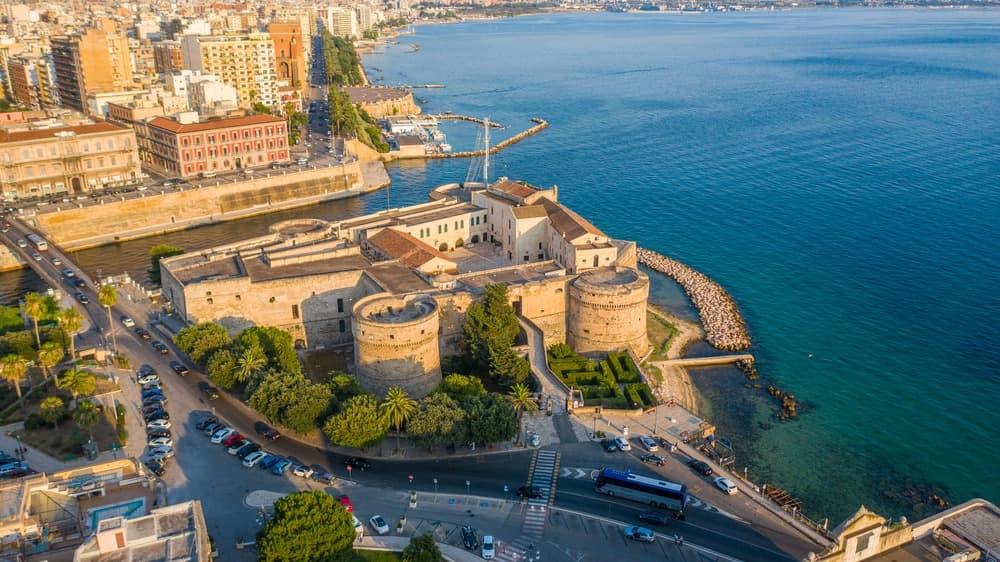
Situated 150 meters above sea level, the Aragonese castle is undoubtedly Taranto's finest architectural masterpiece. In the late 15th century, King Ferdinand II of Aragon ordered construction of this military fortress. Later, the building exchanged its military purpose for use as a penitentiary. On Piazza Castello, visitors are pleasantly surprised to find Doric columns from an ancient temple of Poseidon and refined mosaics, remnants of Greek and Byzantine occupation.
The Cathedral of Taranto
With its flamboyant Baroque façade, executed by architect Mauro Manieri, the Cathedral of Taranto is the city's most celebrated religious monument. The church, built by Byzantines in the 10th century, was first dedicated to Saint Mary Magdalene, then renovated in honor of the Irishman Cataldo, Taranto's patron saint. The interior holds exceptional artworks. Thus, frescos by De Matteis, depicting the saint's life and miracles, cover the dome of the San Cataldo chapel.
The Giverole Bridge
While you're there, don't miss this monumental engineering work. Inaugurated in 1958 by Italian President Giovanni Bronchi, the Giverole Bridge connects the medieval city on Piccolo Lagoon to the mainland. The bridge's view at sunset is remarkable.
The Church of San Domenico Maggiore
Saint Dominic's Church wavers between Romanesque and Gothic art. It occupies the site of an ancient fortress built in 1223 by King Ferdinand II. Its austere façade, adorned with a rose window and Gothic portal, somewhat hints at its military past.
The magnificent Palazzo d'Alaya Valva
Wandering the old town, you'll notice elegant seigneurial residences from the 17th and 18th centuries. Among these, don't miss the Palazzo d'Alaya Valva, which served as a residence for ministers and court members visiting Taranto. The Palazzo Pantaleo and Palazzo d'Amati are also worth exploring. Noble families built their residences in dressed stone, carefully orienting them to enjoy panoramic sea views. Upper floors housed elegant rooms decorated with murals, while ground floors were reserved for servants. The manor typically featured a basement with storage rooms, wine cellars, wells, and cisterns.
When to visit Taranto?
June, July, August, and September are the best months to plan beach holidays in Taranto. The sky is intensely blue during this period, and rainfall is negligible.
You can reach Taranto by air, road, or rail. Taranto-Grottaglie Airport is just 16 km from the city center, though it lacks regular flights. The nearest airports with regular service are Brindisi and Bari. The most practical option is to take the bus or taxi.
You'll love…
- Taking a timeless stroll through the historic center;
- Capturing the baroque cathedral in photographs;
- Paying homage to the Aragonese fortress;
- Visiting the elegant palazzi;
- Admiring the Greek pottery collection at the archaeological museum;
- Sampling local culinary treasures.
Want to discover this destination?
Our local advisors design your tailor-made trip.