Tuscany and Umbria
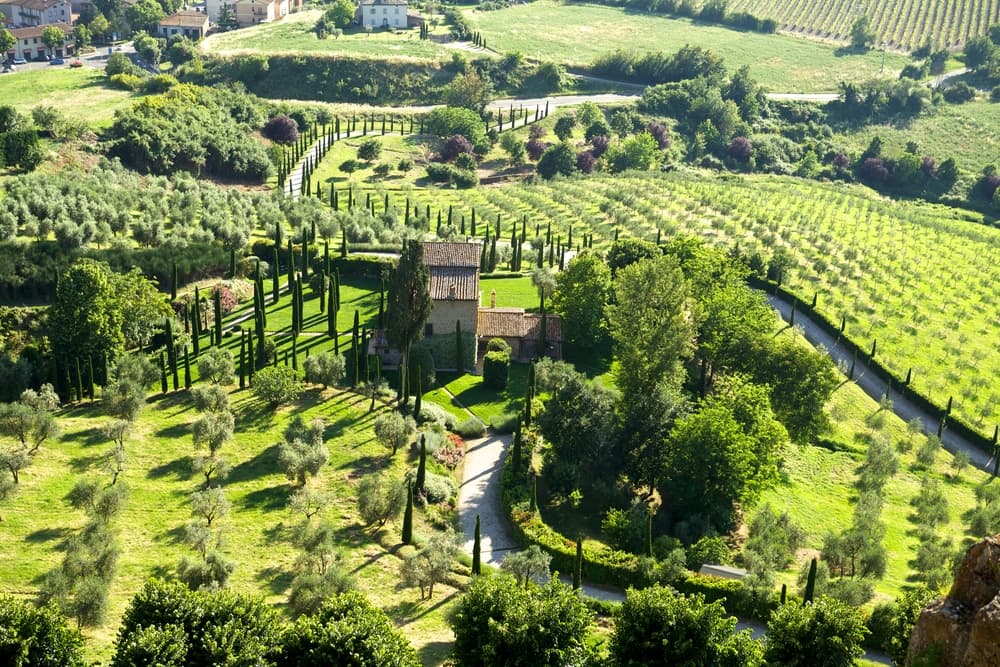
Cypress-lined hills of Val d'Orcia, Chianti vineyards, frescoes of Assisi and the flower-carpeted Castelluccio plateau: two regions best explored at a leisurely pace from an agriturismo.
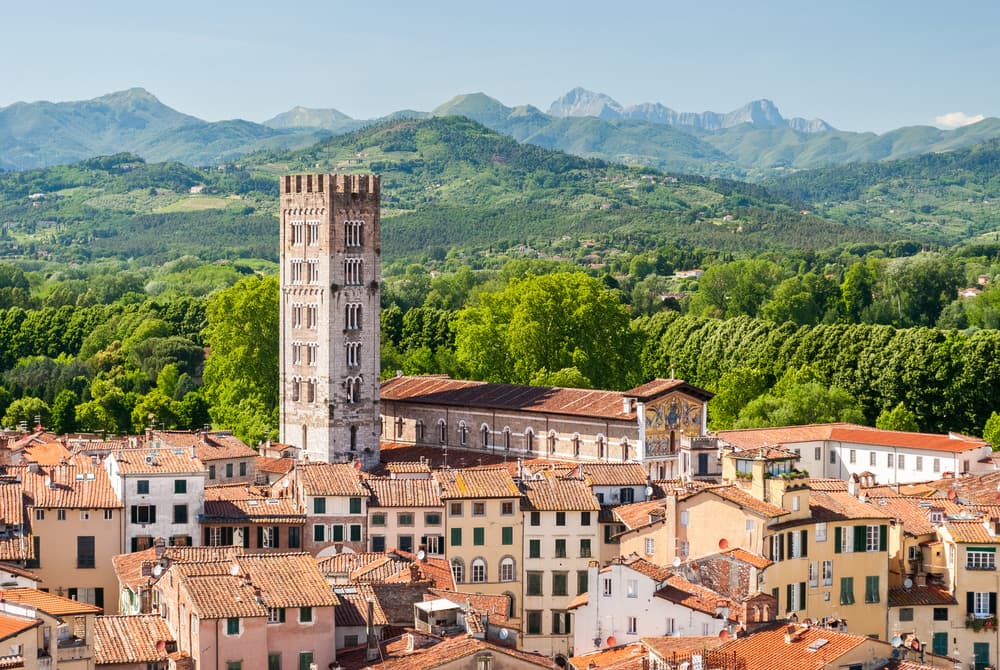
Tuscany and Umbria form a bloc of clay and limestone hills in central Italie, nestled between the Apennines to the east and the Tyrrhenian Sea to the west. The terrain unfolds as a succession of slopes planted with vineyards, olive groves and wheat, punctuated by cypress trees and hilltop villages built from tufa and travertine stone. Our team works these two regions together because they share the same landscape grammar, yet with distinct nuances: Tuscany faces the sea and Florentine commerce, while Umbria remains inward-looking, more monastic, more forested.
On the Tuscan side, Chianti unfolds its vineyards between Florence and Siena over roughly fifty kilometres, around Castellina, Radda and Gaiole. Further south, Val d'Orcia shifts register entirely: grey clays of the Crete Senesi, gentle slopes around Pienza, San Quirico and Montalcino, where brunello is produced. The Maremma, along the Tyrrhenian coast, adds a wilder dimension with its pine forests, marshlands and Etruscan sites of Sovana and Sorano carved into tufa. Siena and its Palio on 2 July and 16 August remain the cultural heart of inner Tuscany, with a cathedral whose marble pavement is rarely fully revealed outside August.
Umbria occupies a more compact territory, without a coastline. Lake Trasimeno, Italy's fourth-largest lake, opens its shores to the northwest near Castiglione del Lago. Assisi concentrates Franciscan memory with the Basilica of Saint Francis and its Giotto frescoes, but the region extends toward Spello with its flower-lined streets in June, Bevagna and its Mercato delle Gaite at month's end, and Montefalco renowned for its sagrantino wine. Further east, the Sibylline range peaks at 2,476 metres at Monte Vettore and offers, on the Castelluccio plateau, lentil fields in bloom from late May through early July. Orvieto, perched on its tufa outcrop to the southwest, often serves as the gateway from Rome with its Gothic cathedral and Etruscan wells.
The cuisine reflects this dual agricultural identity. On the Tuscan side, you find ribollita made with stale bread and black cabbage, bistecca alla fiorentina cut from Chianina cattle, and hand-rolled pici around Montepulciano. Umbria works more with black truffle from Norcia, pork from the same town, lentils from Castelluccio and oils from Trevi and Spello. Wine structures both economies: Brunello di Montalcino, Vino Nobile di Montepulciano, Chianti Classico on the Tuscan side; Sagrantino di Montefalco and Orvieto Classico on the Umbrian side. Most estates welcome visits by appointment, which our team arranges in advance to steer clear of the industrial wineries that have proliferated along tourist routes.
Daily life is still rhythmed by weekly markets (Wednesday in Montepulciano, Thursday in Pienza, Saturday in Arezzo for antiques), by costumed medieval festivals and by an organisation in small communes where you rarely travel more than forty minutes between stops. It's this density, rather than the drama of a single site, that justifies settling into an agriturismo and exploring outward. Hopping between city hotels means missing the region's primary gift: an evening walk through vineyard rows, the white roads of Val d'Orcia at sunrise, villages where you return to dine because you've already found your bearings.
To Discover
Val d'Orcia by slow car. A loop between Pienza, Monticchiello, Bagno Vignoni and San Quirico, with stops on the white roads (strade bianche) lined with cypress. Allow two days to savour it properly.
Siena beyond the Palio. The alleyways of the contrade around Piazza del Campo are best explored on foot early morning, before the heat. Visiting the cathedral and Libreria Piccolomini takes two hours.
Assisi and the Basilica of Saint Francis. Giotto's frescoes depicting the life of Francis occupy the upper basilica, while Cimabue's work adorns the lower basilica. The continuous stream of pilgrims gives the town a particular atmosphere in late afternoon.
Castelluccio plateau in bloom. From late May through early July, lentil fields are covered in poppies, cornflowers and daisies at 1,450 metres altitude, at the foot of Monte Vettore. Access by road from Norcia takes about 40 minutes.
Orvieto and its Etruscan underworld. The cathedral with its polychrome façade and the San Brizio chapel painted by Signorelli, followed by a descent into the Pozzo di San Patrizio, a well with a double helical ramp carved in 1527.
When to Go
We recommend travelling between mid-April and late October, with two preferred windows: May-June and September. In May-June, the hills are green, poppies bloom among the wheat, temperatures hover around 22 to 26°C during the day and drop to 12-14°C at night. September coincides with the start of harvest in Chianti and around Montalcino, with days still warm (24-28°C) and low-angle light that's excellent for photography. July and August are best avoided: temperatures regularly exceed 35°C in Val d'Orcia and around Lake Trasimeno, and major sites (Siena, Assisi, San Gimignano) become overwhelmed by midday.
Winter is more contrasted than one might imagine: snow is possible on the Sibyllins and Monte Amiata between December and March, morning mist is frequent in Umbrian valleys, and rainfall averages around 80mm monthly in November. Many agriturismi close from November to Easter. For black truffle enthusiasts, the season runs from November to February around Norcia and Valnerina, with daytime temperatures between 6 and 12°C.
Practical Advice
We recommend a minimum of seven days on the ground to navigate Tuscany and Umbria without constant transit, and preferably ten to twelve days if adding Florence or the Maremma. Distances remain short (Siena to Assisi in 2.5 hours by car, Pienza to Orvieto in 1.5 hours), but secondary roads impose a leisurely pace—and that's precisely what makes the region special. The most natural logistical entry point remains Rome Fiumicino, 1.5 hours from Orvieto and 2.5 hours from Pienza; Florence Peretola works better if you're starting with Chianti. A rental car is essential; trains serve only the main towns.
The most fluid combination pairs well with Rome and Latium to the south, descending through Orvieto and Tuscia, or with Venice and the Veneto to the north via Bologna. Travellers wishing to continue to the Dolomites and lakes should allow a transition day in Verona or on Lake Garda. Comfort levels are high in upscale agriturismi in Val d'Orcia and Chianti, more modest yet authentic in inner Umbria. This region suits contemplative travellers, art and wine lovers, families with walking-age children, and couples seeking an unhurried stay. Hikers will find plenty to enjoy on trails in the Sibyllins and around Monte Amiata, but this isn't a destination for multi-day trekking.