Massa
Massa
Between the Malaspina fortress, the Versilia beaches and the marble quarries of Carrara, Massa concentrates the essence of northern Tuscany in a single journey.
Massa, the administrative capital of the province of Massa and Carrara, is a highly coveted tourist destination. Learn more about this gem of Tuscany.
Introduction
Established on the northern coast of Tuscany, the Italian city of Massa combines all the assets of a seaside resort. Yet it offers far more than sea, sun and leisure. The "marble city" preserves the memory of the glorious era when it served as the seat of the Duchy of Massa and Carrara, before being invaded by the Bourbons. From church to castle, from streets to historic squares, from palazzo to palazzo, the medieval world is fully integrated into the present. The imagination takes flight, stepping into the society of the dukes and marquises of Massa. These wealthy lords spent their time between hunting, celebrations and banquets; they took up arms against the Saracens; they moved in a world of silverware, silk and precious wood, where luxury infused daily life. Visitors will stroll with pleasure through Italian palaces, in the manner of an eighteenth-century gentleman. For unforgettable holidays in Italy, combining heritage visits, hiking along wine routes or seaside relaxation, Massa is the destination for you.
History
Massa's Roman origins are attested in several parchments. It is mentioned in the Peutinger Table, the roadmap of the Roman Empire, under the name ad Tabernas Frigidas. This suggests that a Roman colony may have existed in the region, but the widely accepted hypothesis is the establishment of rest centers in the area for Roman governors and consuls traveling from Pisa to Luni to fulfill their official duties.
The Middle Ages saw the city take flight on its own wings, acquiring political independence not controlled by Pisa and Florence, the two great powers of Tuscany. From the 15th century until the end of the 18th century, it experienced a feudal regime governed by the Malaspina house and, later, by the Cybo-Malaspina house. The duchy ensured that the city completely transformed. Mercurio Square and Aranci Square appeared. The ducal palace was arranged as an elegant property befitting the name and prestige of the Cybo-Malaspina family.
Economically, the region's reputation is closely linked to the marble sector. The dukes and marquises of Massa owe much of their fortune to the marble deposits of the Apuan Alps, in the neighboring village of Carrara. Today, Carrara marble remains highly sought after worldwide, making the province one of Italy's most active industrial centers.
Key dates and events:
February 22, 1473: The Marquis of Massa purchased ownership of Carrara at a price
April 10, 1557: Alberico I Cybo-Malaspina officially announced the beginning of the city's construction.
15th to 19th century: Massa developed as an independent principality. The Duchy of Massa and Carrara was born.
1829: At the end of the Napoleonic era, the Bourbons had to cede the city—provisionally governed by Bonaparte's sister—to the hands of the Austria-Este family, a cadet branch of the Habsburgs
1859: Massa was annexed to the Kingdom of Sardinia. The region's development was very slow until it was recognized as a provincial metropolis
1944-1945: Allied bombing put Massa through a severe ordeal. The American army occupied the city until April 10, 1945.
Today
Massa, the provincial capital of Massa-Carrara, is home to around seventy thousand inhabitants. Since time immemorial, the inhabitants have cultivated vineyards. The hills of Candia produce a sweet wine with a powerful aroma and fruity notes—Candia wine—which is a source of pride for the region. However, tourism remains the engine of Massa's economy. More than half the population works in hospitality, restaurants and vacation property rentals. The winter resorts in the Aquane Alps are very lively, while at the height of summer, the desire for escape draws floods of tourists to the coast. But like the museum cities of Italy, Massa is above all a major hub of artistic and historical tourism.
Essential places of interest in Massa
During a brief stay in Massa, the city will introduce you to the treasures of medieval architecture. Expect to see charming small squares lined with sanctuaries, fountains, and palaces converted into art museums or character-filled hotels. Just a short distance from the city center, you will visit a protected area where respect and love for nature prevail.
Religious heritage
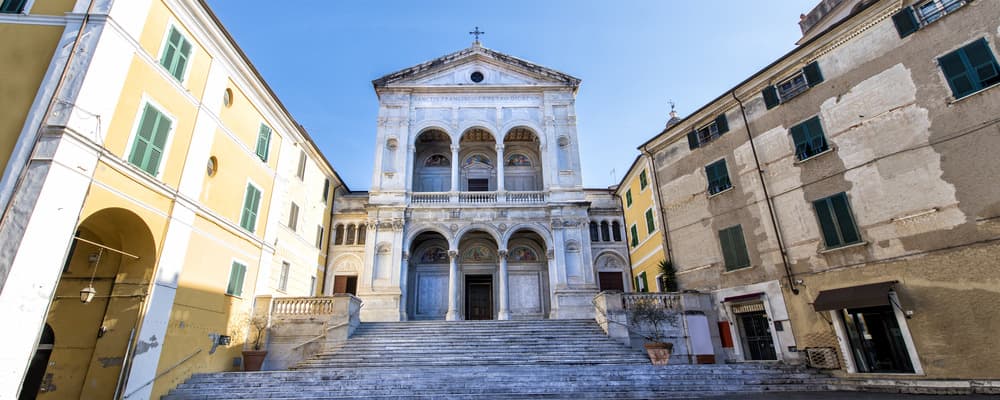
- the cathedral: overlooking the historic district, Massa's cathedral is the mother church of the city. It is more rarely called the "Cathedral of Saint Peter and Saint Francis". The cathedral's façade harmoniously blends the simplicity of Romanesque art with Gothic tendencies. Apart from the high altar in the nave, don't miss the paintings Immaculate Mary (Carlo Maratta) and Trinity in Glory with Saints (Luigi Garzi), which highlight the transept of the church.
- the Church of San Pietro: in the heart of Aranci Square, the Church of San Pietro intrigues visitors with its heavy past. Marquis Alberico I wished to make it the seat of the bishopric of Massa. Unfortunately, the church fell into ruins in 1671. On order of the reigning duke, architect Alessandro Bergamini fully renovated it in 1701. The Baroque church was to be demolished again during the Napoleonic invasion, on the grounds that its bells interfered with the sleep quality of Elisa Baciocchi, the city's princess. This was done in 1807. Thanks to determined excavation work, the church recently regained its former splendor.
- the Church of Sorano: the church relies on its age and Romanesque style to charm tourists. To be discovered in the village of Fillatiera, on the La Spezia national road.
- the Palace of the Doges: don't overlook the monumental Palace of the Doges, nicknamed the "red palace" (palazzo rosso) because of its reddish Renaissance façade. It overlooks the west side of Aranci Square. As you advance into the palace courtyard, observe the statue of Poseidon riding over the waves. The marble portals, the beautifully decorated vaults by Stefano Lemmi, the stucco columns... Everything reflects the grand and luxurious world in which the Cybo-Malaspina lords lived after they took control of the city from the 16th century onward.
Historical and military heritage
The Malaspina fortress: perched on a rocky hill, the Malaspina fortress is undoubtedly the city's most important icon. Dating from 1164, it played a political role in defending the inhabitants against the Saracens. The identity of the architect is unknown, but everything suggests he intended to create a building with a dual role: residential and military. Witness the characteristic keep, as well as the gun ports and bastion walls.
Carrara, "the marble city": in the foothills of the Apuan Alps, hikers will enjoy an open-air museum. Since ancient times, people have worked marble quarries here. Meeting with the craftsmen will be an unforgettable experience for you. They will teach you how to extract, polish and work this precious material.
The Municipal Marble Museum: for a less strenuous but equally enriching stroll, those curious about traditions can visit the museum.
Natural heritage
The Alquane Alps Regional Park: opened in 1985, this park is an ideal observation point for admiring the famous white marble quarries. It offers mountainous, lacustrine and maritime landscapes that go hand-in-hand with picnicking, hiking, boat cruises and paddle racing. Nevertheless, the site's particularity rests on its impressive limestone caves. In this regard, La Grotta del Vento and l'Antro del Corchia present themselves as a living encyclopedia for the study of minerals. A must for speleology enthusiasts!
If skiing appeals to you, head toward the snow-capped peaks of the Lunigiana. Each winter, the Passo Due Santi resort is the meeting place for sledding, toboggan and ice field enthusiasts.
A stay in Massa is inseparable from the pleasures of the sea. Enjoy the dream beaches of Marina di Carrara and Marina di Massa! Enjoy the dolce vita in campsites and international hotels. After swimming, enjoy a sunbathing session accompanied by taglierini with beans, tordella, testaroli, or any other regional specialty of your choice.
When to go?
The climate in Massa is particularly mild and pleasant, due to proximity to the Tyrrhenian Sea. The African sirocco wind softens the severity of winters. On the other hand, rainfall is unpredictable, even in July and August, as the region is surrounded by the Apuan Alps mountain range. Annual precipitation is 1,330 mm.
The best period to plan a vacation in Massa is between June and August. It is unthinkable to visit in spring or autumn, given the heavy storms.
Tourism in Massa depends on inconvenient air transport. There are no round-trip flights serving Massa from European cities like Paris. European nationals must take a flight to Florence or a flight to Pisa and reach central Massa by train or taxi. Florence is 887 km as the crow flies from Paris, about one and a half hours of flight.
Train services connect Paris to Massa-Carrare, with a connection in Lyon.
You will enjoy…
- relaxing on Massa's dream beaches
- discovering the marble quarries of Carrara
- savoring the richness of local cuisine
- photographing the Baroque façade of the Palace of the Doges
- marveling at the magnificent collection of the Cathedral of Saint Peter and Saint Francis
Want to discover this destination?
Our local advisors design your tailor-made trip.