San Gimignano
San Gimignano
San Gimignano, a city of 14 medieval towers listed by UNESCO, combines Renaissance art, Vernaccia wine and Tuscan hillsides between Florence and Siena.
Enclosed by towers and ramparts, San Gimignano's old town captivates every traveler passing through Tuscany. Discover the charms that make this destination unforgettable.
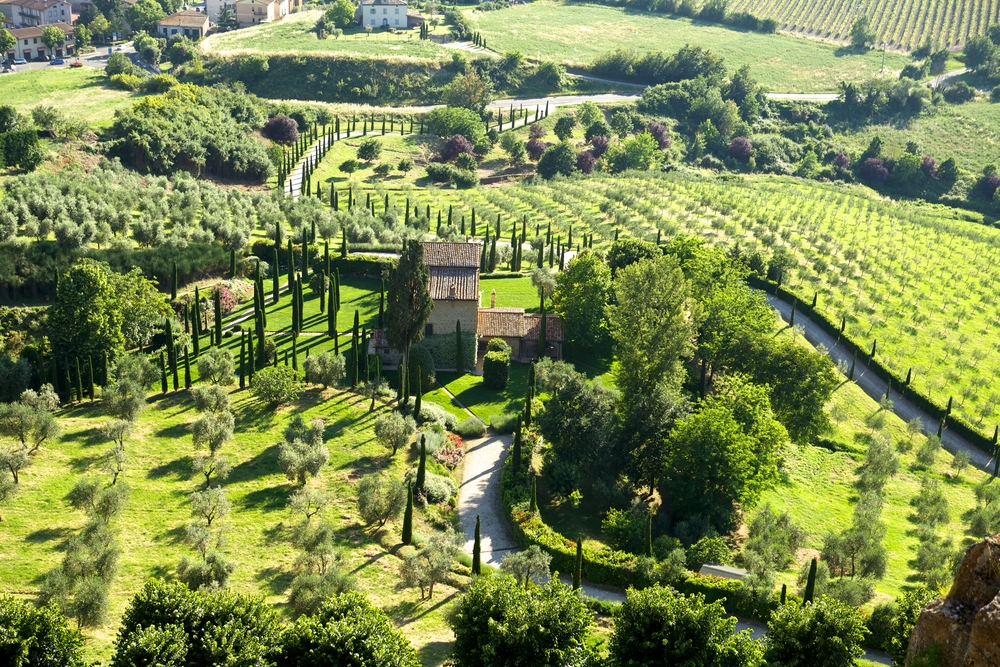
When visiting the land of Michelangelo, it's hard to choose between a romantic escape to Venice or the Eternal City, and a path less traveled but rich in hidden gems. To combine both, a trip to San Gimignano is an excellent idea. Less than 60 kilometers south of Florence, this fortified village perched in the hills has retained an authentic charm. San Gimignano announces Italy of the fine arts, with its bell-towered churches where the creativity of Romanesque, Gothic and Renaissance artists flourishes. From Piazza del Duomo to Piazza della Cisterna, the palazzi, little fountains, and tower houses, including the illustrious Torre Grossa, nod to medieval Italy, captivating all who encounter them. As for nature lovers, the hills flooded with olive groves, wine estates and the distinctive taste of Vernaccia wine will deliver moments rich in emotion. Book your flight to San Gimignano without delay and enjoy an unforgettable Tuscan vacation!
A Brief History
The origin of the city is documented in the annals of the Roman Republic. During the Catilinarian Conspiracy, two noble brothers fled the Roman capital and found refuge in the Elsa valley. The idea of settling there permanently took root when they realized the region's hills were extraordinarily fertile. Each of the two fugitives built a castle on a site once occupied by the Etruscans: one was called Mucchio, the other Silvia. The latter was renamed "San Gimignano" around 500 AD, though the flight itself dates to around the 1st century BC.
The Early Middle Ages were marked by Lombard and Byzantine domination; the ruins of Castelvecchio, overlooking the slopes of Poggio del Commune, stand as testimony. From this troubled period date the village's fortifications. Economic take-off began in 1199, when San Gimignano freed itself from the oversight of the bishops of Volterra, replaced by feudal lords. Didn't chroniclers mention the city as an important stop on the Via Francigena where pilgrims traveling to the Holy See would rest?
San Gimignano quickly acquired international renown when popes and European princely houses learned that its fertile hillsides produced a delicious white wine and saffron. Lucrative exchanges of agricultural products with France, the Netherlands, and neighboring Italian cities swelled the coffers of the ruling classes. To display their political and financial prestige, the powerful rival families competed fiercely to fill the city with residential towers, some reaching heights of up to 70 meters. By the 15th century, there were 72 of them, though fourteen remain visible today. Hence the nickname "San Gimignano dalle belle torri" – or "San Gimignano of the Beautiful Towers" – earned by the city; this distinctive architectural feature earned it a place on the prestigious UNESCO World Heritage list since 1990.
Today
A pearl of Tuscany, San Gimignano is administratively attached to the province of Siena. It has nearly 7,743 inhabitants distributed across six districts, according to the latest 2018 census.
The development of the local economy is inextricably linked to wine. A journey through the hills is enough to understand how many stories, skills and love of terroir are hidden in a glass of Vernaccia San Gimignano wine. This is the name of the dry white wine produced exclusively in this small Tuscan village. A true symbol of San Gimignano, it has been drunk and appreciated regularly since the 15th century by popes and Western noble families. Michelangelo wrote of this liqueur: "it has the art of embracing, licking, biting, pinching and stinging". From the 1960s onwards, San Gimignano experienced the early stages of urbanization; producers abandoned intensive vineyard cultivation to focus on quality. Beyond viticulture, San Gimignano is also known for saffron flowers.
Today, tourism has become the primary source of income for residents. The "San Gimignano of the Beautiful Towers", as locals affectionately call it, combines impeccable medieval architecture with a very rich artistic heritage. Its ideal position, at the intersection between Siena, Pisa and Florence, also works in favor of tourist traffic.
Must-See Attractions
To discover the best of San Gimignano, lose yourself for a moment in the heart of its historic center. From the Cathedral Square to the Cistern Square, a broad array of churches, monuments and medieval towers promises discovery and wonder.
Natural Heritage
Opened in 1996, the Castelvecchio protected area, covering 734 hectares, offers a breath of fresh air just a few kilometers from the city. The integrity of agro-pastoral landscapes and a love and respect for nature are the values that permeate these places. Families will enjoy picnicking, walking through pastures or bird-watching, spotting species like the redstart and the buzzard.
Religious Heritage
- The Collegiate Church of San Gimignano: officially inaugurated in 1148, the Romanesque basilica of Santa Maria Assunta stands in the city's historic center on Piazza del Duomo. While the austerity of the façade with its two portals and three oculus openings creates a modest impression, don't hesitate to cross the threshold: the interior houses paintings of exceptional artistic value.
In the upper part of the counter-façade, the moving scenes of the Last Judgment capture attention: Taddeo di Bartolo depicts the heavenly court composed of angels, prophets, the Virgin Mary and Saint John the Baptist, with Christ as the central figure. On the lateral walls of the nave, the Blessed are gathered in Paradise and, on the left, Hell is represented as a banquet where the Damned gaze greedily without being able to satisfy themselves, their hands held back by horned demons with sharp claws.
Continuing to the Chapel of Saint Fina, you'll also find the monumental frescoes of Domenico Ghirlandaio, considered a masterpiece of Florentine art: on the right, the poor patient receives a visit from Saint Gregory who announces her imminent death, and, above this canvas, the ascension to heaven of the saint by angels is evoked by a vibrant pictorial gesture; on the left, the villagers gathered on either side of the coffin marvel at the miracles performed: the nurse Beldia is healed, touched by the hand of the deceased, the blind priest reads from his breviary, and the church bells are rung by angels.
If you enjoy observing religious paintings, San Gimignano's former cathedral is the best place to indulge your passion. It houses, alongside the Church of Saint Augustine, exquisite paintings from the 14th and 15th centuries.
- The Church of Saint Augustine: the city's second place of worship, this 13th-century edifice built entirely of bricks truly deserves a visit. Its cloister recalls that it was once the property of an Augustinian community. The white marble altar of the San Bartolo chapel, the frescoes by Benozzo Gozzoli depicting the History of the Life of Saint Augustine and the Coronation of the Virgin among Saints and Singing Angels by Piero Pollaiuolo are, among others, the remarkable works of the church.
Monuments and Museums
After the masterpieces of the Italian Renaissance, the number two attraction rests on the tower houses built between the 12th and the end of the 14th century, which give the city its unique character.
- The Torre Grossa: built in 1311 to mark the passage of Dante Alighieri, who arrived in Tuscany in 1300 as an ambassador of the Guelph party, this stone tower magnificently towers over the city at 54 meters high. Don't hesitate to climb to the summit for an unobstructed view of Piazza del Duomo.
- The Rognosa Tower: the city's second-tallest tower, the Rognosa Tower rises above the former Palace of the Podestà. Its height is only two meters lower than that of the Torre Grossa. It's famous for ending rivalries between local elites: the Guelph faction and the Ghibelline faction. According to a municipal decree published in 1255, no civic tower should rise higher than the Rognosa. The twin towers of Salvucci, built by an important Guelph family and visible today on the Piazza delle Erbe, were severely punished for violating the ban: they were reduced to half their original height.
- The Communal Palace: completed in 1288 and later restored in 1323, the Town Hall, also called the Palace of the People or New Palace of the Podestà, **houses the offices of local government. It is, alongside the collegiate church Santa Maria Assunta and the Church of Saint Augustine, one of the best-preserved medieval buildings in the city. The balcony from which the Podestà addressed the crowd is well worth seeing.
- The Civic Museum of San Gimignano: occupying the upper rooms of the Communal Palace, the civic museum founded in 1852 invites you on an artistic escape. The collection houses remarkable works signed by painters, architects and sculptors from the Florentine and Sienese schools and spans the 13th to 16th centuries. The museum's main attraction owes to the genius of Lippo Memmi: a graceful Maestà, in which the Mother of God is enthroned, accompanied by angels and saints crowned with a luminous halo.
Wine Experience
The Vernaccia Museum offers a tour on oenology. Beyond simple tasting, the visit will review the vineyards of the region and serve as an opportunity to deepen knowledge of Vernaccia di San Gimignano: the history of the local white wine, the evolution of its consumption over the centuries, the stages of the winemaking process, from harvest to warehouse storage, are related through multimedia projections. A thematic tour for fine food lovers, wine enthusiasts or those seeking beautiful countryside views.
Best Time to Visit
San Gimignano enjoys a mild Mediterranean climate. Summer corresponds to the peak tourist season, so it's best to avoid this period if you wish to escape record heat (up to 32°C in July and August) and mass tourism. Winter is quite windy and humid. The most favorable period to visit San Gimignano is from September to late October or from March to April. For nature enthusiasts, spring is highly recommended: the vineyard tendrils burst into color as harvest approaches.
For foreign travelers, the easiest way to reach San Gimignano is to book a flight to Florence, and from there, reach the city center by bus, car or train. Florence Airport is less than 2 hours flying distance from Paris. It is served by numerous airlines, such as Air France, Lufthansa, easyJet and Alitalia.
The plane lands at Florence-Peretola Airport, which is just 40 km from San Gimignano. At the airport terminal, you're free to travel by bus, train or taxi to your favorite destination. If you choose the first option, take line 130 from Firenze Autostazione station and get off at Porta San Giovanni station. This will cost you between €4 and €8.
Train services depart both day and night between Florence-Santa Maria Novella station and Poggibonsi-San Gimignano station. The journey takes around 1 hour.
You'll Love…
- enjoying a pleasant view of the historic center from the Torre Grossa;
- admiring the remarkable artistic compositions preserved in the Collegiate Church of Santa Maria Assunta;
- admiring the Renaissance artworks in the Church of Saint Augustine;
- learning all about the legend of the miracles of Saint Fina, the city's patroness;
- taking a look at the medieval towers that have made the city so famous;
- visiting a vineyard estate;
- returning home with salamis, olive oil or saffron, San Gimignano's signature product.
Want to discover this destination?
Our local advisors design your tailor-made trip.